


.png)
Automate multi-step company research with agentic orchestration and structured web intelligence.
Company due diligence is a workflow that shows up everywhere in financial services. PE analysts screen deals, bank credit teams assess borrowers, compliance teams onboard new entities, insurance underwriters evaluate commercial policyholders. The research follows a consistent pattern. Take a company, investigate it across several dimensions, produce a structured intelligence report where every claim has a source trail.
This cookbook builds an agent that automates that workflow by combining LangChain's Deep Agents for orchestration and Parallel's Task API for web research. Deep Agents handles planning, subagent delegation, and context management. Parallel handles the actual research, returning structured findings with per-field citations, reasoning traces, and calibrated confidence scores via Basis. When findings from one track raise new questions, Parallel's interactive research feature lets the agent chain follow-up queries with full context from the prior research thread.
Overview
The agent orchestrates five research tracks, each handled by a dedicated subagent:
- Corporate profile — legal entity structure, key officers, founding history, headcount, office locations
- Financial health — funding history, revenue signals, valuation indicators, profitability markers
- Litigation and regulatory — lawsuits, SEC filings, sanctions screening, regulatory actions, settlements
- News and reputation — recent press coverage, leadership changes, controversy flags, media sentiment
- Competitive landscape — identifies the top three direct competitors and the target's positioning
Once competitive-landscape returns its named list, the orchestrator dispatches a separate competitor-analysis subagent once per competitor, in parallel — the canonical Deep Agents fan-out shape, with each instance running in its own isolated context. The orchestrator then reads every workpaper, cross-references for contradictions and low-confidence findings, runs ad-hoc lookups via Parallel's Search API when discrepancies surface, and writes the final report with risk flags and citation trails.
DD requires this multi-step architecture because earlier findings change what needs to be investigated next. If the corporate profile reveals the target is a subsidiary, the financial analysis needs to cover the parent. If the litigation scan surfaces an SEC investigation, the risk assessment changes. Deep Agents' planning tool lets the orchestrator adapt when findings shift the research plan.
Each research track uses a pro-fast processor Task API call. Validated end-to-end on Rivian Automotive (NASDAQ: RIVN): nine calls in ~23 minutes. See Parallel pricing for current rates.
Implementation
uv pip install deepagents langchain-parallel langchain-anthropicexport ANTHROPIC_API_KEY="your-anthropic-api-key"
export PARALLEL_API_KEY="your-parallel-api-key"
Defining the Parallel research tools
We define two tools. The first wraps Parallel's Task API for structured research with Basis-aware confidence handling. The second uses the LangChain integration's web search tool for quick factual lookups during synthesis.
from typing import Optional

from langchain_core.tools import tool
from langchain_parallel import (
    ParallelTaskRunTool,
    ParallelWebSearchTool,
    parse_basis,
)


@tool
def research_task(
    query: str,
    output_description: str,
    previous_interaction_id: Optional[str] = None,
) -> dict:
    """Run structured web research via Parallel's Task API.

    Returns findings with per-field citations and confidence scores (Basis).
    Use previous_interaction_id to chain follow-up queries that build on
    prior research context.
    """
    runner = ParallelTaskRunTool(
        processor="pro-fast",
        task_output_schema=output_description,
    )
    invoke_args: dict = {"input": query}
    if previous_interaction_id:
        invoke_args["previous_interaction_id"] = previous_interaction_id

    result = runner.invoke(invoke_args)
    parsed = parse_basis(result)

    output = result["output"]
    findings = output.get("content") if isinstance(output, dict) else output

    response: dict = {
        "findings": findings,
        "citations_by_field": parsed["citations_by_field"],
        "interaction_id": parsed["interaction_id"],
    }
    if parsed["low_confidence_fields"]:
        response["low_confidence_warning"] = (
            "These fields came back with low confidence and should be "
            "verified, ideally by chaining a follow-up query with "
            "previous_interaction_id: "
            + ", ".join(parsed["low_confidence_fields"])
        )
    return response


# Quick search tool for fast factual lookups during synthesis
quick_search = ParallelWebSearchTool()
The tool does three things beyond a raw API call. It calls parse_basis(result) to extract per-field citations and the names of any low-confidence fields. It surfaces those names as an explicit low_confidence_warning in the tool's return value, so the calling subagent's reasoning loop can decide to chain a follow-up. And it returns the interaction_id so the chained call can anchor to the same research thread via previous_interaction_id.
Defining the research subagents
Each research track gets its own subagent with a specialized system prompt and access to the research_task tool.
corporate_profile_subagent = {
    "name": "corporate-profile",
    "description": "Research corporate structure, leadership, founding history, and headcount",
    "system_prompt": """You are a corporate research analyst.

Given a company, use the research_task tool to find:
- Legal entity name, incorporation state/country, founding date
- Current CEO and key executives (names, titles, approximate tenure)
- Headquarters location and major office locations
- Employee headcount (current and recent trend)
- Corporate structure (parent company, major subsidiaries)

For the output_description parameter, request these as structured fields.

If the result includes a low_confidence_warning, chain a follow-up query
using the returned interaction_id to verify the flagged fields.

Write your findings (including citations_by_field) to corporate-profile.md.""",
    "tools": [research_task],
}
The other Phase-1 subagents (financial-health, litigation-regulatory, news-reputation, competitive-landscape) follow the same shape with their own focused prompts. The full set is in agent.py.
The Phase-2 fan-out subagent is invoked once per competitor identified by competitive-landscape:
competitor_analysis_subagent = {
    "name": "competitor-analysis",
    "description": "Produce a focused profile of one named competitor",
    "system_prompt": """You are a competitive intelligence researcher.

The orchestrator will pass you a single competitor name and the original
DD target. Make one research_task call requesting:
- Corporate snapshot (HQ, public/private, headcount, founding year)
- Most recent revenue and growth signals
- Funding or market cap status
- Product / positioning vs. the original DD target
- Recent strategic moves in the last 12 months
- Notable strengths and weaknesses relative to the target

Write your findings to competitor-<slug>.md.""",
    "tools": [research_task],
}
Creating the orchestrator agent
The main agent coordinates the subagents, reviews findings for contradictions, and produces the final report. We back it with a FilesystemBackend so workpapers and the final memo persist to disk under ./reports/ rather than evaporating with the agent state.
from pathlib import Path

from deepagents import create_deep_agent
from deepagents.backends.filesystem import FilesystemBackend

REPORTS_DIR = Path("./reports")
REPORTS_DIR.mkdir(parents=True, exist_ok=True)

diligence_instructions = """\
You are a senior due diligence analyst managing a team of specialized
researchers. Your job is to produce a comprehensive company intelligence
report with verifiable claims.

## Your Process

1. **Plan the research**: Use write_todos to lay out the diligence as a
   checklist. Phase 1 dispatches the five Phase-1 subagents. Phase 2
   dispatches one competitor-analysis subagent per competitor identified
   by competitive-landscape.

2. **Phase 1 — parallel research**: Use the task tool to dispatch
   corporate-profile, financial-health, litigation-regulatory,
   news-reputation, and competitive-landscape concurrently.

3. **Phase 2 — competitor fan-out**: Read competitive-landscape.md and
   parse the three named competitors. Dispatch a separate
   competitor-analysis subagent instance per competitor, in parallel.

4. **Review and cross-reference**: Read every workpaper. Look for
   contradictions, low-confidence findings, and gaps. Use quick_search
   for ad-hoc lookups during synthesis.

5. **Synthesize the report** with: executive summary, corporate profile,
   financial overview, litigation and regulatory risk assessment, news
   and reputation analysis, competitive landscape (with per-competitor
   sub-sections), confidence and verification notes, and key risk flags.

## Citation and Confidence Guidelines

- Include source URLs for key claims.
- Call out any finding where confidence was low. These need human verification.
- If two tracks produced contradictory information, note the discrepancy
  explicitly with citations from both sources.
"""

agent = create_deep_agent(
    model="anthropic:claude-sonnet-4-6",
    tools=[quick_search],
    subagents=[
        corporate_profile_subagent,
        financial_health_subagent,
        litigation_subagent,
        news_reputation_subagent,
        competitive_landscape_subagent,
        competitor_analysis_subagent,
    ],
    system_prompt=diligence_instructions,
    backend=FilesystemBackend(root_dir=REPORTS_DIR, virtual_mode=True),
)
Running the agent
result = agent.invoke({
    "messages": [{
        "role": "user",
        "content": "Conduct a full due diligence report on Rivian Automotive",
    }]
})

print(result["messages"][-1].content)
Streaming execution progress
For long-running diligence runs, stream the agent's progress to see planning, tool calls, and subagent activity in real time. Pass subgraphs=True to receive events from inside subagent execution.
for chunk in agent.stream(
    {"messages": [{"role": "user", "content": "Conduct a full due diligence report on Rivian Automotive"}]},
    stream_mode="updates",
    subgraphs=True,
    version="v2",
):
    if chunk.get("type") == "updates":
        source = f"[subagent: {chunk['ns']}]" if chunk.get("ns") else "[orchestrator]"
        print(f"{source} {chunk.get('data')}")
Observability with LangSmith
Why observability matters for FSI
In FSI, regulators, auditors, and risk teams increasingly expect firms to reconstruct how AI-assisted outputs were produced, especially when those outputs influence material business decisions. Six months from now, an internal auditor, compliance reviewer, model-risk team, investment committee, or regulator may ask how an AI-assisted diligence memo was produced. Which sources informed each material conclusion? What confidence was attached? Where did a human review or override the output? Was the agent’s process logged well enough to reconstruct? In FSI, “the agent gave me an answer” is not a defensible control posture.
The agent compounds non-determinism (LLM output, prompt sensitivity, the open web), spends real money on real web research, and ends in a memo a regulator may eventually audit. Every claim has to map back to a primary source with an explicit confidence label, and that mapping has to remain auditable months after the run finishes. Once the agent reaches production, most of its failures surface there too, where pre-launch testing rarely catches them. The trace is the artifact that survives the run.
This is why the trace matters in FSI specifically:
- Logging is increasingly mandated. The EU AI Act requires automatic event logging for high-risk AI systems, and US bank regulators apply model risk management expectations to AI agents in practice even where formal scope is unsettled. The trace is the artifact both frameworks contemplate.
- Decision explainability requires per-claim grounding. When AI input feeds a regulated decision such as consumer credit, investment recommendations, or any process subject to fiduciary obligations, the institution has to explain how that input was formed. The basis payload (source URLs and per-output confidence) is what makes that explanation reproducible months after the run.
- Third-party AI requires ongoing supervision. The stack uses an external model provider and an external research API (Parallel). A trace records what was sent to each provider, what came back, and how those outputs influenced the final memo, supporting issue investigation and vendor oversight.
- Operational resilience depends on fast root-cause analysis. If an agent failure contributes to a material operational disruption or reportable ICT incident, the trace gives teams a concrete starting point for reconstruction, remediation, and reporting.
How compliance and audit work today
FSI teams already have a system for proving how a research memo was produced: analyst workpapers, citation lists, source approvals, version history, and compliance review. That model works because the analyst is the unit of accountability. When an examiner, auditor, or compliance reviewer asks how a conclusion was reached, the analyst can walk through the reasoning, with workpapers and citations backing up the final deliverable. AI agents change that model.
The “analyst” is no longer just a person. It is a graph of LLM calls, tool invocations, retrieved sources, intermediate outputs, and state transitions. Unless those steps are captured at runtime, the final memo may survive, but the process that produced it can disappear into logs, context windows, and vendor calls that are difficult to reconstruct later. The trace restores the attach point. It becomes the machine-side workpaper: an inspectable record of which sources informed each material conclusion, what confidence was attached, which tools were called, where human review occurred, and how the final output was produced.
What LangSmith captures
LangSmith records every Deep Agents step and every ParallelTaskRunTool invocation in this agent: the prompt the subagent constructed, the URLs Parallel returned, the basis payload with confidence, and the structured findings, with no changes to the agent code. Each run is also broken down into per-node cost across every model call, tool call, and subagent, so you can see exactly which step drove which share of tokens and time. When two runs come back at very different cost, the trace shows whether the difference lives in subagent reasoning, additional Parallel calls, or the final synthesis pass.
What the trace shows
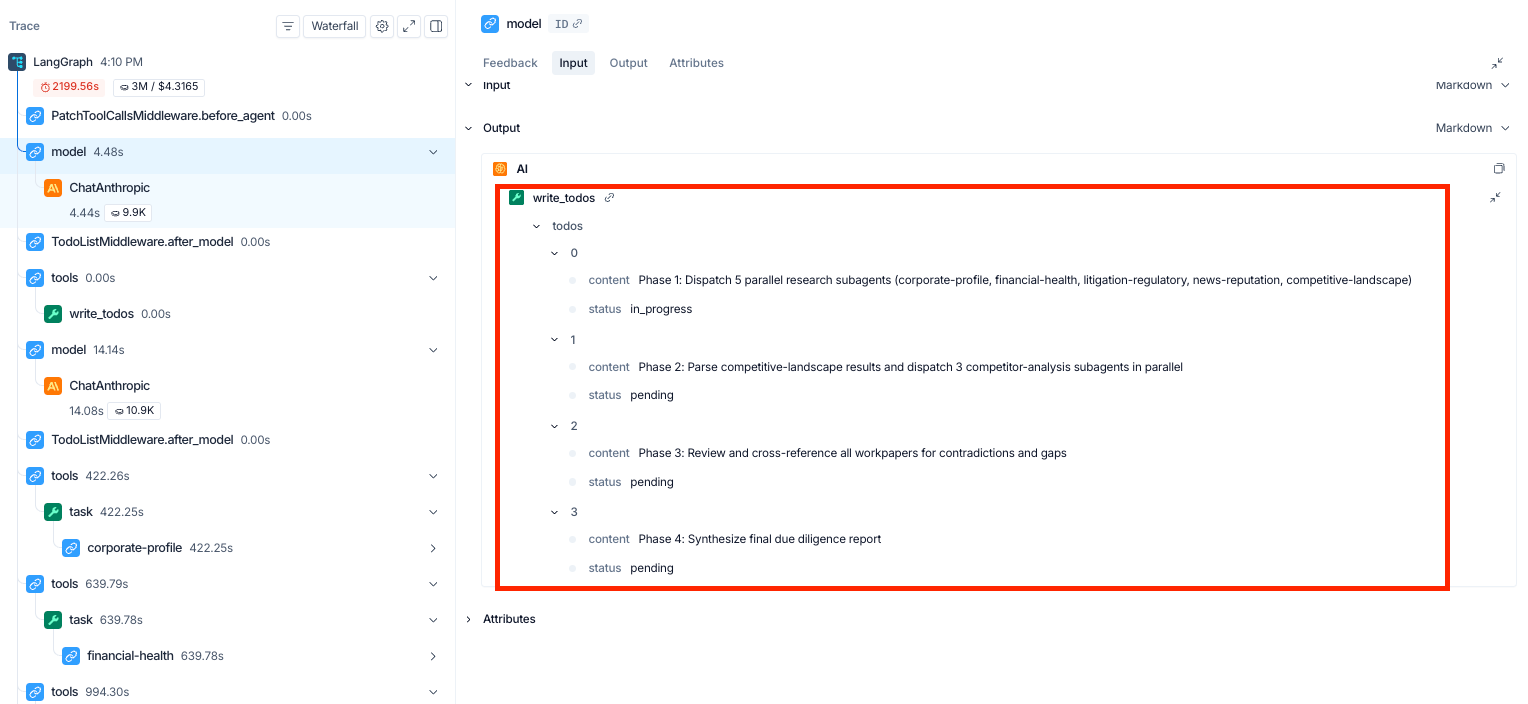
Open any run and the first thing you see is the orchestrator's plan: a four-phase TODO that lays out the research strategy before any subagent runs.
Phase 1 then dispatches all five research subagents in parallel: corporate-profile, financial-health, litigation-regulatory, news-reputation, and competitive-landscape. Each subagent receives a focused mission described in plain English in the dispatch tool call. Click into any of those task nodes in the trace and you can see exactly what that subagent is doing: the prompt it issued, the Parallel calls it made, and the sources that came back.
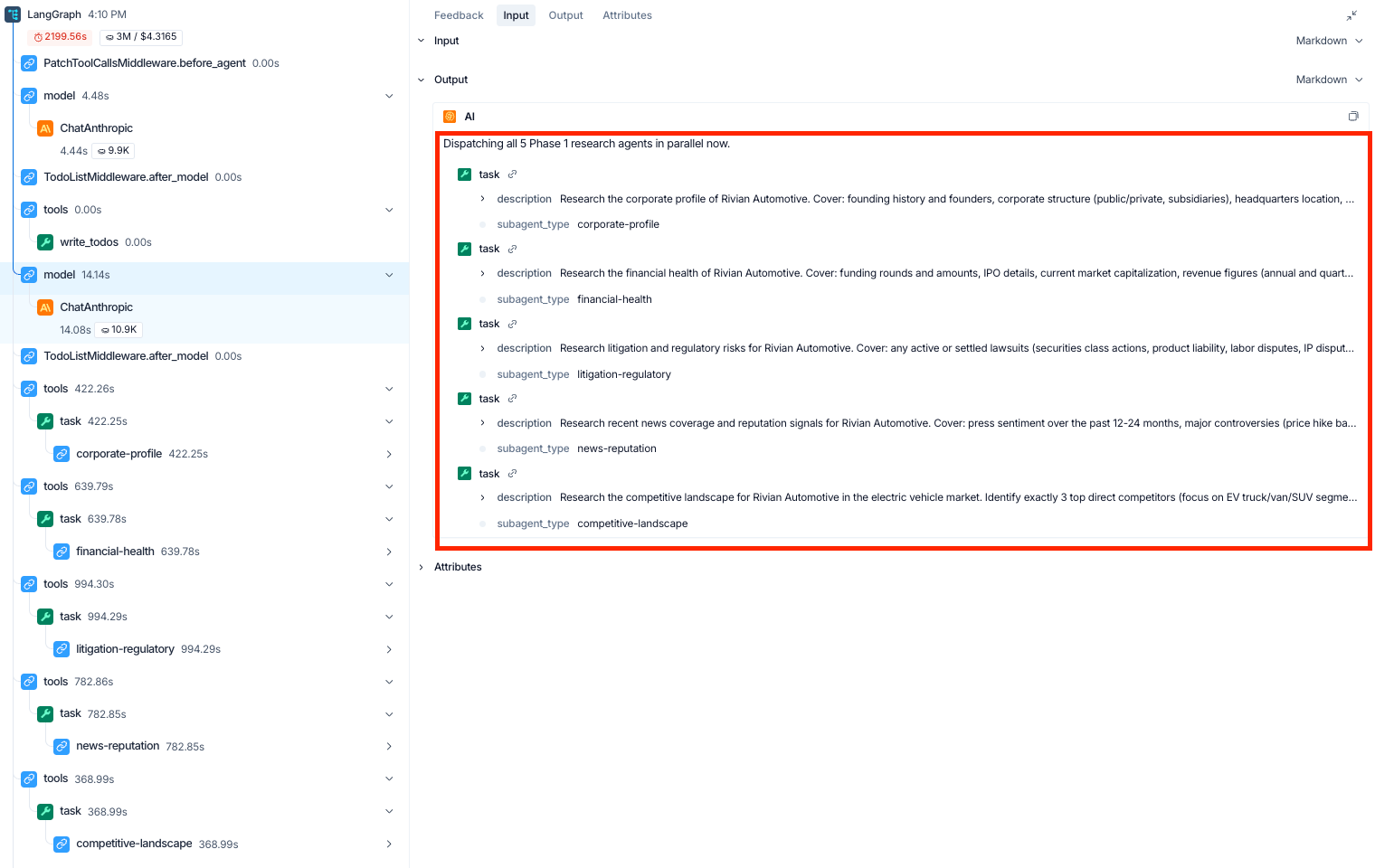
After Phase 1 completes, the orchestrator fans out per-competitor analyses (Phase 2), cross-references workpapers for contradictions (Phase 3), and synthesizes the final memo (Phase 4). Every tool call is captured along the way.
Selecting any subagent's research_task shows the full structured findings Parallel returned: every field, every excerpt, and every URL, including content beyond the summary that lands in the workpaper.
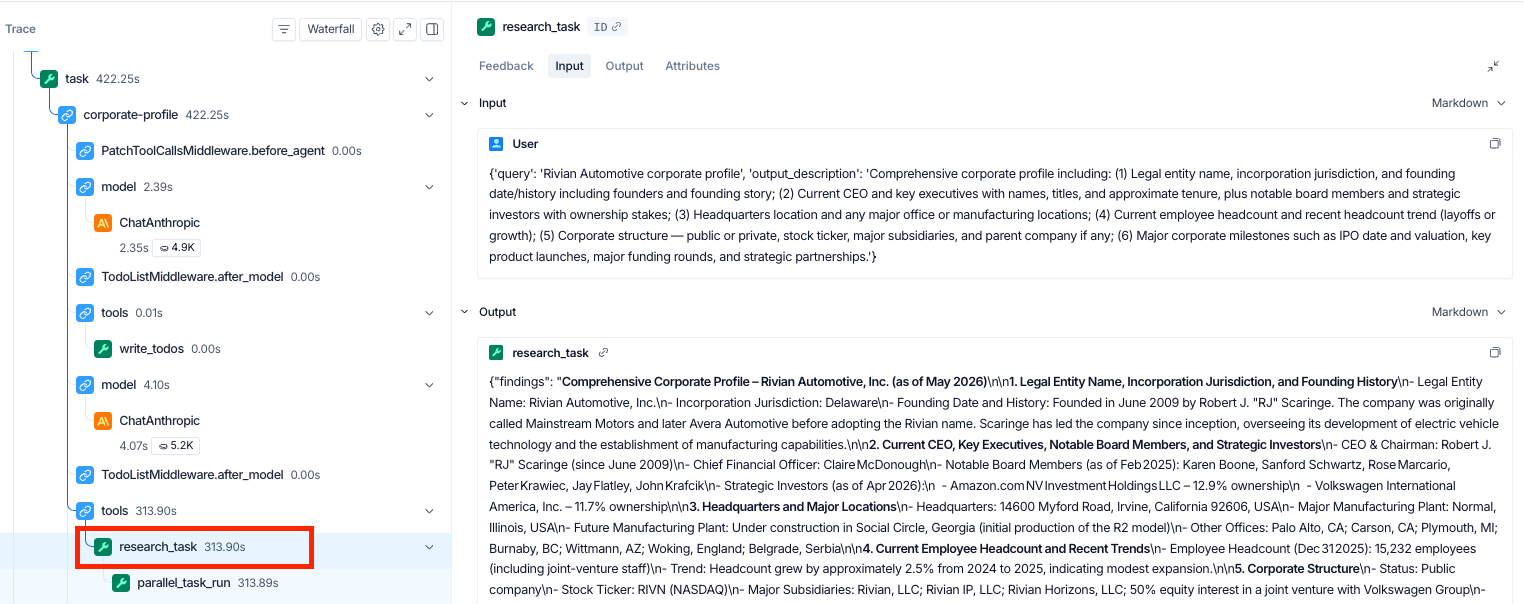
Citations and confidence
For a compliance reviewer, the relevant view is the basis payload inside parallel_task_run. Parallel attaches each output with source URLs, a confidence label (high / medium / low), and a one-line reasoning trace explaining how the answer was assembled.
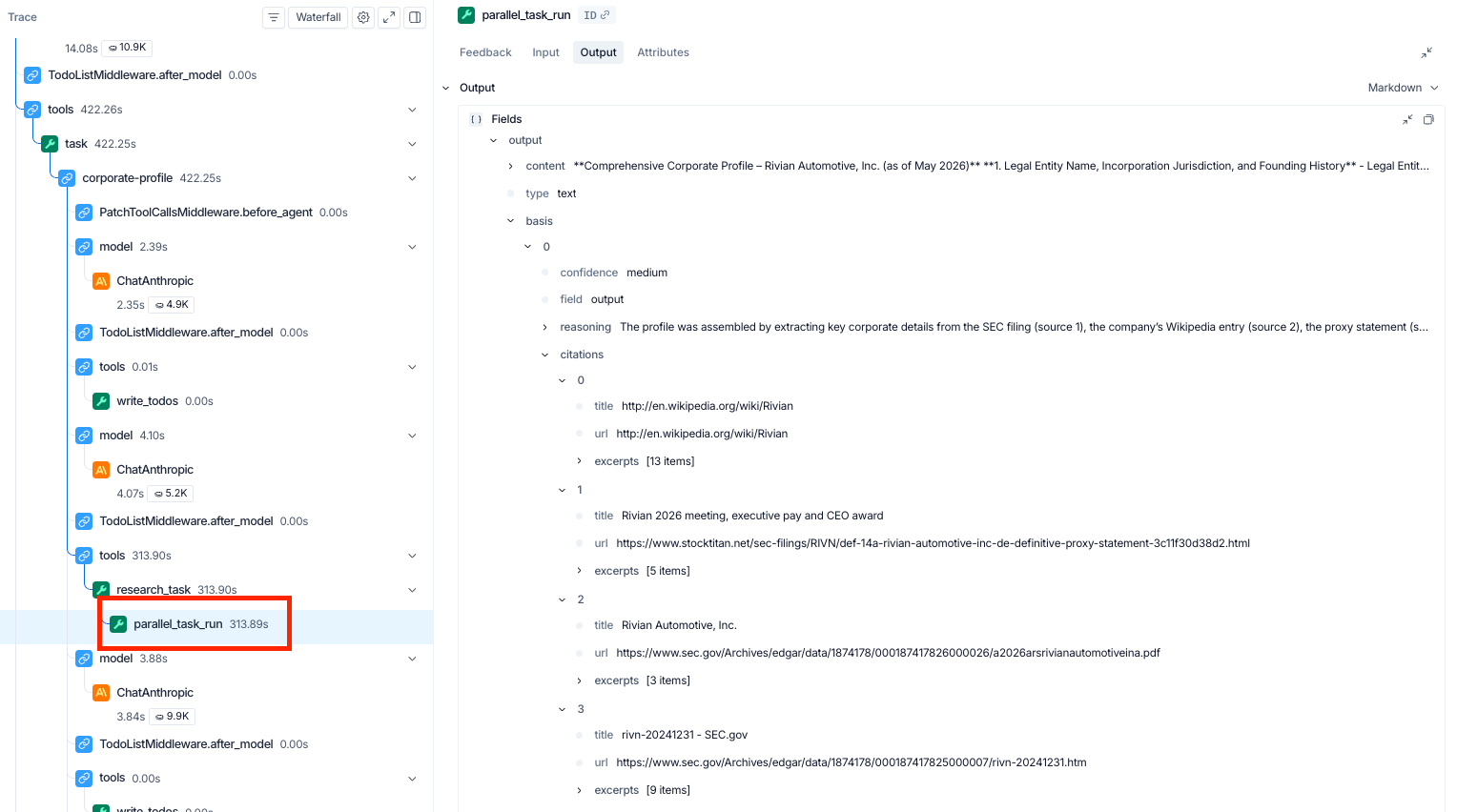
In the Rivian corporate-profile call shown above, the agent's medium-confidence output is grounded in four sources: Rivian's 10-K and 2026 annual report on SEC.gov, a third-party reproduction of the 2026 proxy statement, and Wikipedia. That mix of two primary SEC filings, one secondary reproduction, and one tertiary source is exactly the kind of grounding pattern a compliance reviewer would want to flag. With the trace, the grounding is inspectable per claim, and sourcing patterns like this one become correctable across runs. A workpaper without this layer would list the same four URLs flat, with no signal about which were primary.
Beyond a single trace
For one DD memo, the trace is the audit trail. For a portfolio of memos run across a quarter, you also need pattern discovery: which subagent produces the most low-confidence outputs, which targets force the most chained Parallel follow-ups, which sources have started returning thinner content. LangSmith builds on the trace foundation with cross-run analytics for exactly that. For an FSI team running diligence at scale, that capability turns an audit trail into an operating discipline.
Who this is for
This architecture applies to any team running structured research workflows on companies, including deal screening, credit underwriting, KYB/KYC onboarding, M&A target evaluation, and vendor risk assessment.
The five research tracks here are a starting point. Swap in tracks relevant to your workflow: add management background checks and beneficial ownership tracing for compliance-heavy diligence, add IP portfolio analysis for M&A screening, add SOC 2 verification for vendor assessment. Each additional track is a new subagent dict with a system prompt and the same research_task tool.
Resources
- Full source code
- Deep Agents documentation
- Parallel Task API
- Parallel Basis and citations
- Parallel interactive research
langchain-parallelSDK- Get a Parallel API key