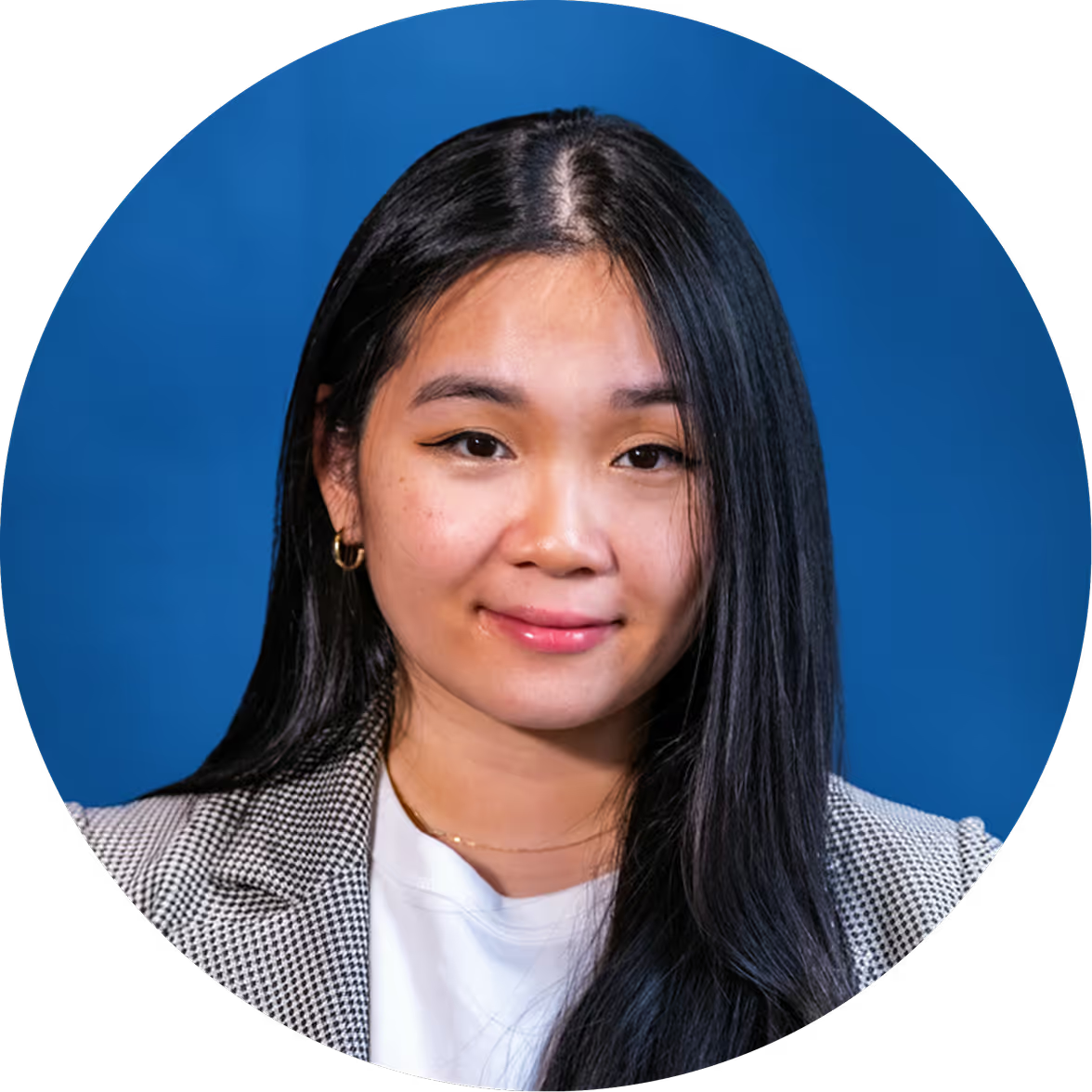

In just 15 days, we’ll be welcoming you to the second-ever Interrupt, The Agent Conference. Today, I’d like to introduce you to the MC of the event, Jake Broekhuizen.
.png)
Originally from Australia, Jake came to the U.S. to study Electrical Engineering and Computer Science at UC Berkeley. He was drawn to the West Coast because it seemed like the most interesting place to work on hard technical problems.
His first role out of college was as a software engineer at ServiceNow, where he got a ground-level education in how large enterprises actually function. Partway through, he moved into an ML engineering role with a specific mandate: build a platform to make OpenAI’s APIs usable across ServiceNow's business units. It was late 2022 and ChatGPT had opened everybody’s eyes to the power of LLMs, but Jake’s team still needed to answer the question, “how do you connect them to your actual workflows and data in a way that's genuinely useful?”
That problem is what led him to LangChain. He had already been a fan of the open-source libraries, but in building this new AI platform at ServiceNow, he got a broader view of how LangSmith fit into the picture and what the vision for an enterprise-ready agent engineering platform looked like.
He left the first meeting ServiceNow had with LangChain with one clear thought: I want to work there. The deployed engineer role was a natural fit—a way to stay deeply technical while having in-depth conversations with the companies trying to figure out how to build with LLMs for the first time.
Jake joined as one of LangChain's first deployed engineers and has loved every minute since. The problem he'd been solving at ServiceNow, connecting data and context to LLMs in a way that actually works, turned out to be exactly what LangChain's products were built for. ServiceNow is still a customer today.
Jake is thrilled to be emceeing the event, and I got the chance to sit down for a quick Q&A to preview Interrupt, discuss trends in the industry, and more:
What was last year’s conference like? Why should people come back for round 2?
Last year's Interrupt was all about the arrival of agents in the enterprise and the rise of Agent Engineering as a discipline—knowing how to translate business logic into effective prompts and code-based workflows that leverage the power of LLMs. A year later, it's clear that agents are truly here to stay, and the conversation has evolved. This year it's all about how enterprises can make agents ubiquitous, the architectures that are emerging as the most effective, and the ways we can leverage agent outputs to create self-improving loops. If last year was about proving agents work, this year is about making them work better, at scale - and that's why people should come back.
When it comes to this year’s Interrupt agenda, what are you most looking forward to?
There is so much to look forward to that it's honestly really hard to choose! Personally, I've been doing a lot of work with customers around multi-agent architectures and how they scale in production. Evan Kormos from Coinbase is presenting on how they scaled AI support with a multi-agent system—so that's one I'm really looking forward to.
As someone who works closely with our customers and hears customer stories regularly, what makes Interrupt a worthwhile conference?
I think that for many of us it feels like the industry is moving at a million miles an hour, and whilst that is really exciting, it can make it hard to ground the developments we see on a daily basis in the real, practical work of building agents.
Interrupt is designed to do just that—to create a space where builders present to other builders on how they are turning these developments into real business outcomes. Whether it's Fortune 500 enterprises or up-and-coming companies building at the frontier, every talk is rooted in what's actually working in production—and that's what makes it worth being in the room.
Can you tease any of the product announcements that attendees can expect to hear?
Through working with companies across financial services, healthcare, security, customer service and more, we've seen consistent patterns emerge around the way people are looking to build, test, and continuously improve their agents.
While I can't dive into specifics, I can say that people are really keyed in on how they can take the tools in LangSmith around observability, evals, and deployment and use them not just for humans to improve agents, but for agents to improve agents—and making that iteration flywheel go faster.
On top of that, we're seeing more teams want total control over the environments their agents operate in, and the ability to analyze agent behavior at scale without compromise on performance. We have some pretty exciting announcements coming on all three fronts, so you'll want to be in the room.
What are some recent developments that have impacted the agent landscape?
I think the rise of coding agents like Claude Code, Codex and Cursor's agent have made it very clear that a purpose-built agent harness can drive extremely powerful outcomes. An agent is the combination of a model and a harness, and the harness is every piece of context, code, configuration, and execution logic that isn't the model itself.
With the success of these coding agents, the industry is waking up to the fact that the harness is where the real differentiation happens—not just which model you're using, but how you orchestrate it, what tools you give it, and how you feed its outputs back into improving the system.
That insight is now spreading well beyond coding into customer service, healthcare, finance - really every domain where agents are being deployed. It's a pivotal shift in how people think about building agents.
What trends do you foresee in the development of agents in 2026 and beyond?
I think there are a few trends that really stand out. First, closing the loop is going to become table stakes. The best agent teams are already building feedback cycles where production outputs feed back into evaluation and improvement, and in 2026 I think that shifts from being a competitive advantage to a baseline expectation.
Second, I think we'll see agent harnesses specialize by domain. Just as coding agents proved that a purpose-built harness unlocks a step change in capability, we'll see the same pattern play out in healthcare, finance, customer service and beyond. Generic agent frameworks will give way to deeply specialized harnesses tuned to specific workflows.
And third, agents become fleet-scale infrastructure. Enterprises are going to stop thinking about "an agent" and start thinking about managing hundreds or thousands of agents as a fleet. I think that changes everything—observability, governance, evaluation all need to work at a fundamentally different scale.
Do you have any recommendations for San Francisco for those visiting for the first time?
I think San Francisco is one of the most naturally beautiful cities in the world, and I’m a sucker for a good view. Just as you cross the Golden Gate bridge, you can take a turn-off that takes you to the top of Hawk Hill. At the viewpoint from the top, if you look right you’re taken out over the expanse of the Pacific and if you look left, the Golden Gate frames the city and the surrounding bay—it truly is an unbeatable view and one that you can’t miss if you’re visiting SF for the first time.
To meet Jake in-person and hear from industry leaders like Harrison, Andrew Ng, Chirantan “CJ” Desai, Aaron Levie, and the teams at Cisco, Lyft, LinkedIn, and more, get your tickets today.