The best AI agent frameworks in 2026
We reviewed 7 AI agent frameworks across orchestration, observability, and production readiness. See how LangGraph, CrewAI, Microsoft Agent Framework, and others compare.
June 6, 2026
Your agent works in local testing. Then you ship it, and something subtle breaks. The wrong tool gets picked. A long-running conversation loses context. Token spend triples because an agent gets stuck in a loop you cannot reproduce.
A framework earns the label "best" if it helps you prevent those failures and diagnose them fast when they happen. We have seen this pattern across thousands of teams shipping agents. The framework you choose determines what you can build quickly. The observability and evaluation layer you pair it with determines whether what you build keeps working once it ships.
We evaluated seven options across developer experience during prototyping, production reliability, observability and debugging support, ecosystem integrations, and pricing transparency, so you can match the right framework to your stack, not just your prototype.
This guide compares seven frameworks: LangChain, CrewAI, Microsoft Agent Framework, LlamaIndex Workflows, Google ADK, OpenAI Agents SDK, and Mastra.
TL;DR
- Choose LangChain if you need an open-source framework for rapid prototyping across model providers, paired with LangGraph for stateful multi-agent orchestration, Deep Agents for long-running workflows, and LangSmith for enterprise-grade observability and evaluation across the full application lifecycle.
- Choose CrewAI if you need role-based multi-agent prototypes up and running quickly with an intuitive mental model.
- Choose Microsoft Agent Framework if you're on the Microsoft stack and want the unified successor to AutoGen and Semantic Kernel, with graph-based workflows, responsible AI guardrails available through Azure AI Foundry, and Python + .NET runtimes at 1.0 GA.
- Choose LlamaIndex Workflows if you need event-driven orchestration for document-heavy, data-intensive pipelines.
- Choose Google ADK if you're GCP-native and want an opinionated, batteries-included agent runtime with built-in debugging UIs.
- Choose OpenAI Agents SDK if you need tightly scoped assistants and clean multi-agent delegation with minimal abstraction.
- Choose Mastra if you're a TypeScript team building production agents and want workflows, memory, and a Studio environment in one package.
Get a demo of LangSmith's agent engineering platform
The best AI agent frameworks at a glance
What makes a great AI agent framework?
The best agent frameworks give developers clear primitives for tool calling, state management, and inter-agent communication without hiding what's happening underneath. Abstraction is only useful when it accelerates the right decisions; abstraction that obscures failure modes costs more in debugging time than it saves in setup time, which is why the most trusted frameworks expose enough internals to reason about agent behavior at every step.
Production readiness separates frameworks that work in demos from those that hold up under real workloads. Durable execution, reliable state persistence, and predictable error handling matter far more once an agent is handling real user requests than during prototyping. Frameworks that require bolting on external systems like Temporal or Redis just to achieve basic reliability push that complexity onto the team rather than absorbing it.
The right choice depends on what your team is optimizing for: speed to first working prototype, control over complex multi-agent state, language ecosystem fit, or depth of cloud provider integration. A framework that's excellent for a Python team building document-heavy pipelines may be a poor fit for a .NET enterprise team or a TypeScript shop shipping production agents, which is why evaluating against your actual stack matters more than evaluating against benchmarks.
How we evaluated these tools
We reviewed technical documentation, official GitHub repositories, and public pricing pages for each framework, then analyzed community feedback from Reddit, Hacker News, and GitHub Issues to surface real-world friction points that documentation rarely surfaces. Every limitation cited in this guide traces to a specific community source.
We compared frameworks across several dimensions: developer experience during prototyping, production reliability, observability and debugging support, and ecosystem integrations.
Every solution was assessed on the capabilities they actually document and ship, not on roadmap claims.
We believe in LangChain, but we have done our best to give every tool here a fair assessment. If LangChain is not the right fit, one of these alternatives probably is.
LangChain
Quick Facts:
- Type: Open-source framework for building LLM applications
- Company: LangChain
- Open Source: Yes (MIT)
- GitHub: 134k stars at
github.com/langchain-ai/langchain
LangChain is the most widely adopted open-source framework for building AI agents and LLM applications, with ~134k GitHub stars and more than 1,000 pre-built integrations connecting models to data systems, vector databases, and external APIs.
Its core value is breadth: teams can swap model providers with a one-line code change, compose chains and agents from modular components, and move from a working prototype to a production-grade system without switching frameworks.
The framework pairs natively with LangGraph for stateful, cyclic multi-agent orchestration, Deep Agents for long-running workflows, and with LangSmith, a framework-agnostic observability platform, for tracing, evaluation, and systematic debugging in production. That combination gives teams a path from rapid prototyping to metric-driven engineering without stitching together unrelated tools, though the abstraction layers that make early development fast can become friction points when debugging edge cases in complex workflows.
Who should use LangChain?
LangChain fits teams that need to move quickly across a broad set of agentic use cases, from RAG pipelines to tool-calling agents to multi-step workflows, without committing early to a single model provider. It's a strong fit for teams that expect to iterate heavily on prompts and model choices during development, and for organizations that want a single framework that pairs with LangSmith for observability, evaluation, and deployment across the application's entire lifecycle.
Standout features
- Provider abstraction: Swap between OpenAI, Anthropic, Google Gemini, AWS Bedrock, and others without rewriting application logic
- LangGraph pairing: Native support for our separate orchestration framework, built for stateful, cyclic multi-agent systems with loops and human-in-the-loop control
- Deep Agents pairing: Native support for our open source agent harness built for long-running tasks. It handles planning, context management, and multi-agent orchestration for complex work like research and coding
- LangSmith pairing: Our framework-agnostic agent engineering platform for tracing, evaluation, deployment. It offers systematic debugging, capturing costs, latency, and response quality at every step, along with LangSmith Engine for automatically prioritizing agent issues and suggesting a PR fix
- 1,000+ integrations: Community-maintained connectors for vector databases, document loaders, tools, and APIs via
langchain-community - Composable primitives: Modular components including text splitters, retrievers, and output parsers that work as standalone utilities outside full chain architectures
FAQ
Q: Does LangChain work with models outside of OpenAI?
Yes. LangChain's model provider abstraction layer supports OpenAI, Anthropic, Google Gemini, AWS Bedrock, Hugging Face, and many others. Switching providers typically requires changing one line of code, and the community-maintained langchain-community package extends coverage further. The abstraction is designed so that application logic doesn't need to change when the underlying model does.
Q: What's the difference between LangChain, LangGraph, and Deep Agents?
LangChain is the broader framework for building LLM applications, including chains, retrievers, and tool-calling agents. LangGraph is a separate, lower-level orchestration framework for building stateful multi-agent systems that require loops, persistence, and cyclic reasoning. Teams typically start with LangChain and reach for LangGraph when their agent architecture needs explicit state management across multiple steps or agents.
Deep Agents is an agent harness for long-running workflows, such as coding and research agents.
Q: Is LangChain suitable for production, or just prototyping?
LangChain works in production, but teams often find that the abstraction layers that accelerate prototyping require careful management at scale. The framework's heavy dependency footprint and release cadence mean version upgrades require careful management. Pairing it with LangSmith for observability and evaluation helps teams catch reliability issues before they become production incidents. LangSmith Engine automatically prioritizes agent issues and suggests a PR fix.
Q: How does LangSmith relate to LangChain?
LangSmith is a standalone observability platform built by LangChain that works with any LLM framework, not just LangChain and LangGraph. It provides tracing, evaluation, and debugging for production AI applications regardless of whether the underlying application uses LangChain, LangGraph, Deep Agents, the OpenAI Agents SDK, or custom code. Teams using LangChain get native integration, but LangSmith doesn't require it and is framework agnostic.
CrewAI
Quick Facts:
- Type: Multi-agent orchestration framework
- Company: crewAI
- Open Source: Yes (MIT)
- GitHub: ~49.2k stars at
github.com/crewAIInc/crewAI - Website: crewai.com
CrewAI is a standalone multi-agent orchestration framework built around a role-based mental model where each agent has a defined persona, a set of tools, and a specific task within a larger crew. The framework is designed for speed of initial setup: developers consistently report that the abstractions are intuitive enough to get a working multi-agent prototype running faster than with most alternatives. CrewAI explicitly avoids dependencies on LangChain or other external agent frameworks, positioning itself as a self-contained alternative.
The framework supports OpenAI as the default model provider, with explicit support for local runtimes via Ollama, and integrates with a range of tools including web scraping, PostgreSQL, MongoDB Vector Search, Qdrant, and Weaviate. It also supports the Model Context Protocol (MCP) across stdio, SSE, and streamable HTTP transports, which extends its integration surface for teams building tool-heavy workflows.
Who should use CrewAI?
CrewAI fits teams that need a working multi-agent prototype quickly and whose workflows map naturally to distinct agent roles with clear task boundaries. It's a good choice for automation use cases like email triage, content publishing pipelines, and research workflows where the mental model of a crew of specialists is a genuine fit for the problem structure, and where the underlying model handles tool-calling reliably.
Standout features
- Role-based agent model: Each agent has a defined persona, goal, and backstory, making it easy to reason about agent responsibilities and design collaborative workflows
- Broad tool integrations: Official connectors for web scraping, file search, PostgreSQL, MySQL, MongoDB, Qdrant, Weaviate, Serper, and Exa
- Local model support: Ollama integration for teams that need to run agents without cloud API dependencies
- Rapid prototyping: Intuitive abstractions that reduce time from concept to working prototype for role-based workflows
- MCP support: Full MCP client support across stdio, SSE, and streamable HTTP transports via
MCPServerAdapter
FAQ
Q: Is CrewAI reliable enough for production use, or is it primarily a prototyping tool?
CrewAI works in production for well-scoped workflows where the underlying model handles tool-calling reliably, but community feedback surfaces meaningful gaps. Like any framework relying on LLM-generated tool calls, CrewAI agents can produce action traces that don't reflect actual execution (also #3095), and asynchronous crew execution and frontend streaming are documented pain points. Teams shipping production workloads should build explicit validation around tool execution and plan for additional engineering work beyond the happy path. The Free tier caps out at 50 workflow executions/month, so non-trivial production use typically means moving to an Enterprise contract.
Q: Does CrewAI support models other than OpenAI?
Yes, but with varying reliability. CrewAI supports Ollama for local runtimes, and community members have deployed it with non-OpenAI providers through OpenAI-compatible endpoints. However, non-OpenAI integrations and memory system connections are among the most frequently cited friction points in community feedback (see #3811, #4036, #2591), and dependency management during framework upgrades can break these integrations unexpectedly (see #3750 and #4079).
Microsoft Agent Framework
Quick Facts:
- Type: Multi-agent orchestration framework and SDK
- Company: Microsoft
- Open Source: Yes (MIT)
- GitHub: ~9.6k stars at
github.com/microsoft/agent-framework
Microsoft Agent Framework is the unified successor to AutoGen and Semantic Kernel, built by the same teams and announced in October 2025 as Microsoft's single orchestration SDK going forward. It combines AutoGen's conversational multi-agent abstractions with Semantic Kernel's enterprise features (session-based state management, middleware, telemetry, and type safety) and adds graph-based workflows for explicit control over multi-agent execution paths.
The framework ships with Python (pip install agent-framework) and .NET (Microsoft.Agents.AI), and supports Microsoft Foundry, Azure OpenAI, OpenAI, Anthropic, Amazon Bedrock, Google Gemini, and Ollama out of the box.
Beyond the core orchestration layer, it integrates with Azure AI Foundry for observability and responsible AI features such as task adherence, PII protection, and prompt injection defense, and Microsoft contributes to OpenTelemetry's GenAI semantic conventions for agent telemetry.
Migration assistants for both Semantic Kernel and AutoGen are included. Microsoft also committed to maintaining Semantic Kernel v1.x with bug fixes and security patches for at least one year after MAF GA. AutoGen shifts to maintenance mode on a similar timeline. New feature investment goes to Agent Framework.
Who should use Microsoft Agent Framework?
Microsoft Agent Framework fits enterprise teams already invested in the Microsoft stack (Azure AI Foundry, Azure OpenAI, .NET services) who want a first-party orchestration layer with OpenTelemetry observability and optional responsible AI guardrails through Foundry. It's the right choice for teams currently on AutoGen or Semantic Kernel who need a forward-compatible path, for .NET shops that want a first-class C# runtime alongside Python, and for organizations that want multi-agent patterns (sequential, concurrent, handoff, group chat, Magentic-One) bundled with migration tooling out of the box.
Standout features
- Graph-based workflows: Explicit multi-agent execution paths with type-safe routing, checkpointing, and human-in-the-loop support for debugging complex orchestration across agents
- Multi-agent orchestration patterns: Sequential, concurrent, handoff, group chat, and Magentic-One patterns shipped as first-class primitives
- DevUI inspector: Browser-based sample app for running agents and workflows locally with OpenTelemetry trace viewing. Microsoft explicitly notes DevUI is a sample and not intended for production use
- Azure AI Foundry integration: When deployed through Foundry, agents can opt into task-adherence guardrails that keep them on-task, PII protection that flags sensitive data access, and prompt injection defenses
- Protocol support: Native MCP (Model Context Protocol) support in core; A2A (Agent2Agent) support via the separate
agent-framework-a2aadapter package (currently beta; Microsoft's 1.0 GA blog post flags "A2A 1.0 support coming soon") - Python and .NET at GA: Both runtimes shipped 1.0 simultaneously on April 3, 2026, with declarative YAML agent configuration for version-controlled deployments and migration assistants from Semantic Kernel and AutoGen
FAQ
Q: What happens to existing AutoGen and Semantic Kernel projects?
New development is directed to Agent Framework, and Microsoft publishes migration guides from both predecessors. Existing AutoGen or Semantic Kernel applications will continue to receive bug fixes and security patches during the support window, so they keep running while teams plan migration. Teams planning long-term investments in the Microsoft stack should migrate to capture new features, open-standards support (MCP native, A2A today, with A2A 1.0 coming soon), and Azure AI Foundry integration.
Q: Is Microsoft Agent Framework production-ready for non-Microsoft stacks?
The 1.0 release stabilizes the core single-agent abstraction, middleware, memory, graph-based workflows, and multi-agent orchestration patterns across Python and .NET, and supports non-Microsoft providers including Anthropic, Bedrock, Gemini, and Ollama. That said, community-reported issues cluster in orchestration design trade-offs such as sequential context handling and function-approval scoping, and in provider adapters outside the Azure OpenAI happy path (see #5008, #2524). Teams shipping on non-Azure infrastructure should validate provider integration thoroughly and plan for additional work on edge cases that the Azure-first testing path hasn't exercised.
Q: Can Microsoft Agent Framework be monitored with LangSmith?
Yes. LangSmith publishes a dedicated Microsoft Agent Framework tracing guide that uses Agent Framework's native OpenTelemetry instrumentation to route traces to LangSmith through the standard OTLP exporter. Since Agent Framework emits OTel spans natively via configure_otel_providers(), teams can capture Agent Framework execution in LangSmith alongside workflows built on the LangChain framework, LangGraph, Deep Agents, or custom code, without requiring any LangChain dependency in the Agent Framework app itself.
LlamaIndex (Workflows)
Quick Facts:
- Type: Agent workflow and orchestration framework
- Company: LlamaIndex
- Open Source: Yes (MIT)
- GitHub: 347 stars (Python) at
github.com/run-llama/llama-agents(formerlyworkflows-py). The TypeScript workflows package (workflows-ts) is deprecated; the team directs users to the Python Workflows inllama-agents.
LlamaIndex Workflows is an event-driven orchestration layer for building multi-agent systems in plain Python or TypeScript, without requiring a separate domain-specific language. The framework models agent execution as a graph of event handlers, where each step emits and receives typed events, making it straightforward to compose nested or parallel agent pipelines. For teams already using LlamaIndex for data loading and retrieval, Workflows integrates naturally with that ecosystem, allowing data-heavy pipelines to flow directly into orchestrated agent steps.
The Workflows component can be embedded into existing Python scripts, notebooks, and REST APIs via Starlette and FastAPI middleware. Deployment targets include Llama Cloud via llamactl and containerized self-hosting (including AWS Bedrock AgentCore via the AgentCore CLI). LlamaParse, LlamaIndex's commercial OCR and document extraction product, feeds directly into Workflows pipelines.
Who should use LlamaIndex (Workflows)?
LlamaIndex Workflows fits developers building document-centric, data-intensive multi-agent systems who want event-driven orchestration in plain code. It's a strong choice for teams already invested in the LlamaIndex data ecosystem, where the framework's document loading, parsing, and retrieval capabilities are a natural upstream complement to the orchestration layer. Teams comfortable with boilerplate in exchange for explicit control over event flow will find the architecture more intuitive than alternatives.
Standout features
- Event-driven orchestration: Typed event model where each step emits and receives events, enabling composable and inspectable agent pipelines without a separate DSL
- LlamaIndex data ecosystem integration: Direct access to LlamaParse for OCR and document extraction through LlamaCloud, and the broader LlamaIndex retrieval and loading tooling
- Python-first (actively maintained): Python implementation with Starlette and FastAPI middleware support. The TypeScript
workflows-tspackage is deprecated, and the team directs users to the Python Workflows package. - Cloud deployment targets: Llama Cloud via
llamacplus containerized self-hosting (including AWS Bedrock AgentCore via the AgentCore CLI). - Notebook and script embedding: Workflows run cleanly in scripts and notebooks without requiring a dedicated orchestration server
FAQ
Q: How mature is LlamaIndex Workflows for production multi-agent systems?
The framework is functional but carries documented production risks, particularly around the AgentWorkflow abstraction, which has exhibited handoff failures where receiving agents stop responding (see llama_index #18530, #17745). Observability is also a gap: tracing integrations have known issues with concurrent execution, resulting in dropped spans and partial traces (see Langfuse discussion #4637). Teams shipping production workloads should validate agent handoffs thoroughly and plan for additional observability tooling beyond what the framework provides natively.
Q: Is LlamaIndex Workflows a good fit for teams not using the broader LlamaIndex data ecosystem?
The Workflows component can run independently of the broader LlamaIndex data tooling, but the strongest use case for the framework is when teams are already using LlamaIndex for document loading, parsing, and retrieval. Without that upstream integration, the event-driven orchestration model requires meaningful boilerplate to set up, and teams without a document-centric use case may find graph-based alternatives like LangGraph or lower-abstraction options like the OpenAI Agents SDK a better fit.
Google ADK (Agent Development Kit)
Quick Facts:
- Type: Agent development framework and SDK
- Company: Google
- Open Source: Yes (Apache 2.0)
- GitHub: 19k stars at
github.com/google/adk-python
Google ADK is an opinionated, batteries-included agent development framework designed to make it fast to build, debug, and deploy AI agents on Google Cloud infrastructure. The framework ships with built-in session management, a browser-based debugging UI (ADK Web), code execution support, and a CLI (adk run, adk api_server) that makes it straightforward to expose agents as services without writing server boilerplate. Deployment targets include Cloud Run, GKE, and Vertex AI Agent Engine, with deep integration into existing GCP services like IAM, Pub/Sub, and BigQuery.
The framework supports the Model Context Protocol (MCP), the Agent2Agent (A2A) protocol, and OpenAPI specs for tool integration, and positions itself as model-agnostic despite its GCP deployment orientation. Teams outside the Google Cloud ecosystem will need to build their own bridges to connect ADK components to non-GCP infrastructure, as the framework's opinionated defaults are optimized for GCP-native deployment patterns.
Who should use Google ADK?
Google ADK fits GCP-native teams that want an opinionated, end-to-end agent runtime with built-in debugging tooling and a clear path to production on Google Cloud. It's a strong choice for teams already using Vertex AI, Cloud Run, or GKE who want to avoid assembling a custom agent stack from scratch, and for organizations that can benefit from deep integration with existing GCP services like IAM, Pub/Sub, and BigQuery.
Standout features
- Developer-first CLI:
adk web,adk run, andadk api_servermake it fast to prototype, debug, and expose agents as services without writing server code - Built-in debugging UI: Browser-based ADK Web interface for inspecting agent execution without setting up external tooling
- GCP deployment integration: Direct deployment to Cloud Run, GKE, and Vertex AI Agent Engine with minimal configuration
- Session management: Built-in session handling with a Memory Bank for persistent agent memory across interactions
- Protocol support: MCP, A2A, and OpenAPI spec integration for connecting agents to external tools and services
- Code execution support: Built-in code execution environment, reducing boilerplate for agents that need to run and evaluate code
FAQ
Q: Is Google ADK suitable for teams not using Google Cloud?
Google ADK can run outside GCP, but its default assumptions and deployment tooling are optimized for Google Cloud infrastructure. Teams not using Cloud Run, Vertex AI, or other GCP services will find that the framework's batteries-included benefits diminish quickly, since those benefits come from deep integration with GCP-specific services. Non-GCP teams would need to build custom deployment and state management layers that other frameworks provide more generically.
Q: How does ADK handle agent memory and state persistence?
ADK includes a built-in Memory Bank for persistent agent memory and session management, but community feedback surfaces a critical gap: in-memory session states are lost when Cloud Run containers restart, and improper persistent storage configuration has caused different users to see each other's session data. Teams deploying to Cloud Run should configure external persistent storage explicitly and validate session isolation before shipping to production.
OpenAI Agents SDK
Quick Facts:
- Type: Multi-agent workflow SDK
- Company: OpenAI
- Open Source: Yes (MIT)
- GitHub: 22.2k stars at
github.com/openai/openai-agents-python
The OpenAI Agents SDK is a lightweight, low-abstraction framework for building multi-agent workflows using OpenAI's model APIs. Its design philosophy favors minimal API surface over comprehensive abstractions: the core primitives for agent handoffs, tool calling, and delegation are clean and easy to reason about, which makes it faster to understand what an agent is doing than with heavier orchestration stacks. Built-in tracing provides debugging visibility into agent execution during prototyping, and the framework integrates with MCP for connecting agents to external tools.
The SDK includes session primitives with support for common storage backends (e.g., SQLite, Redis, SQL-based stores). Workloads that need workflow-level durable execution across process restarts typically pair the SDK with Temporal or DBOS, since the SDK doesn't absorb that complexity natively. LangSmith, as a framework-agnostic observability platform, can monitor OpenAI Agents SDK workflows without requiring any LangChain dependency.
Who should use OpenAI Agents SDK?
The OpenAI Agents SDK fits developers building tightly scoped assistants or delegation-based agent workflows on OpenAI’s model stack who want to stay close to the API without heavy orchestration overhead. It’s a strong choice for teams building tool-driven applications with MCP-compatible interfaces, for prototyping agent architectures where clarity of execution matters more than feature breadth, and for organizations comfortable managing durability and state persistence through external systems.
Standout features
- Minimal API surface: Low abstraction design makes agent execution easy to reason about and faster to debug than heavier frameworks
- Clean handoff primitives: Built-in multi-agent delegation and handoff patterns that are intuitive to design around
- Built-in tracing: Native execution tracing for debugging agent behavior during prototyping without external tooling setup
- MCP integration: Model Context Protocol support for connecting agents to GitHub, Notion, local filesystems, and other tools
- LiteLLM compatibility: Optional multi-provider routing for teams that need to run agents on non-OpenAI models
- Redis session state: Optional Redis integration for low-latency, in-memory caching of session state and other shared data across agent runs. Durability is opt-in through RDB snapshots or AOF logs, and production deployments should configure replication with Sentinel or Cluster failover so Redis doesn't become a single point of failure.
FAQ
Q: What are the real costs of running the OpenAI Agents SDK in production?
The SDK itself is free, but production costs are driven entirely by OpenAI API usage. At the time of publication, GPT-5.4 input tokens start at $2.50 per million tokens, with GPT-5.4 nano as the lowest-cost option at $0.20 per million input tokens. Multi-agent workflows that chain multiple model calls can accumulate costs quickly, and teams should instrument token usage per trace early to avoid surprises at scale.
Mastra
Quick Facts:
- Type: AI agent and application framework for TypeScript
- Company: Mastra (from the team behind Gatsby)
- Open Source: Partial (Apache 2.0 for core; Mastra Enterprise License for ee/ directories)
- GitHub: ~23k stars at
github.com/mastra-ai/mastra
Mastra is a TypeScript-first agent framework built by the team behind Gatsby, designed to give JavaScript and TypeScript developers a batteries-included path to building production agents without assembling separate libraries for workflows, memory, and observability. The framework ships with built-in workflow orchestration, a dedicated Studio environment for development and debugging, and a Memory Gateway for persistent agent memory, which reduces the number of external systems teams need to manage before shipping a production agent.
The framework integrates with React, Next.js, and Node, and connects to the Vercel AI SDK UI and CopilotKit for frontend wiring. Mastra's opinionated defaults accelerate development on the happy path, but community feedback indicates those same defaults can become restrictive for teams with workflows that diverge from the framework's assumptions (see #8726 and #2968).
Who should use Mastra?
Mastra fits TypeScript-heavy teams building production custom agents who want a single framework that covers workflows, memory, and observability without stitching together separate libraries. It's a strong choice for teams already working in React and Next.js ecosystems who want frontend-to-agent integration without custom middleware, and for organizations that can accept the framework's opinionated defaults in exchange for faster time to production.
Standout features
- TypeScript-first developer experience: Designed for TypeScript environments with types and conventions that feel natural compared to JavaScript ports of Python-first frameworks
- Batteries-included platform: Workflows, observability, memory, and a Studio environment in one package, reducing dependency on external tooling
- Memory Gateway: Built-in persistent memory with configurable retention, token limits, and retrieval storage, available as a standalone service
- MCP server integration: Model Context Protocol support for connecting agents to external tools and data sources
- Frontend integrations: Vercel AI SDK UI and CopilotKit compatibility for wiring agents to React and Next.js frontends
- Mastra Studio: Dedicated development and debugging environment for building and testing agent workflows
FAQ
Q: Is Mastra a good choice for teams coming from Python-first frameworks?
Mastra is designed for TypeScript and JavaScript environments, and its strongest value is for teams already working in those ecosystems. Teams migrating from frameworks like LangChain or AutoGen will find the TypeScript conventions more natural than JavaScript ports of Python SDKs, but should expect a meaningful context switch in how workflows and memory are modeled. LangChain offers both TypeScript and Python frameworks.
Q: How does Mastra's memory pricing work at scale?
Mastra's Memory Gateway starts free with 100,000 memory tokens and 250MB retrieval storage, stepping up to $250/team/month for 1M memory tokens and 1GB retrieval storage. Beyond the pricing tiers, teams should be aware that default Observational Memory settings trigger background model compression as conversation volume grows, which generates additional API costs separate from the Memory Gateway subscription. Monitoring token usage from the memory layer early is important to avoid cost surprises at scale.
The full LangChain ecosystem
Every other framework in this comparison gives you an orchestration layer. You pick observability, evaluation, and deployment separately, then stitch them to agents that were designed before those systems existed.
We built the LangChain ecosystem to cover an AI agent's entire application lifecycle as a connected set of products:
- LangChain: our open-source framework for LLM applications with 1,000+ integrations, composable primitives, and one-line model provider swapping for rapid prototyping
- LangGraph: a separate orchestration framework for stateful, cyclic multi-agent systems that need loops, persistent memory, and human-in-the-loop control
- Deep Agents: our open source agent harness built for long-running tasks. It handles planning, context management, and multi-agent orchestration for complex work like research and coding
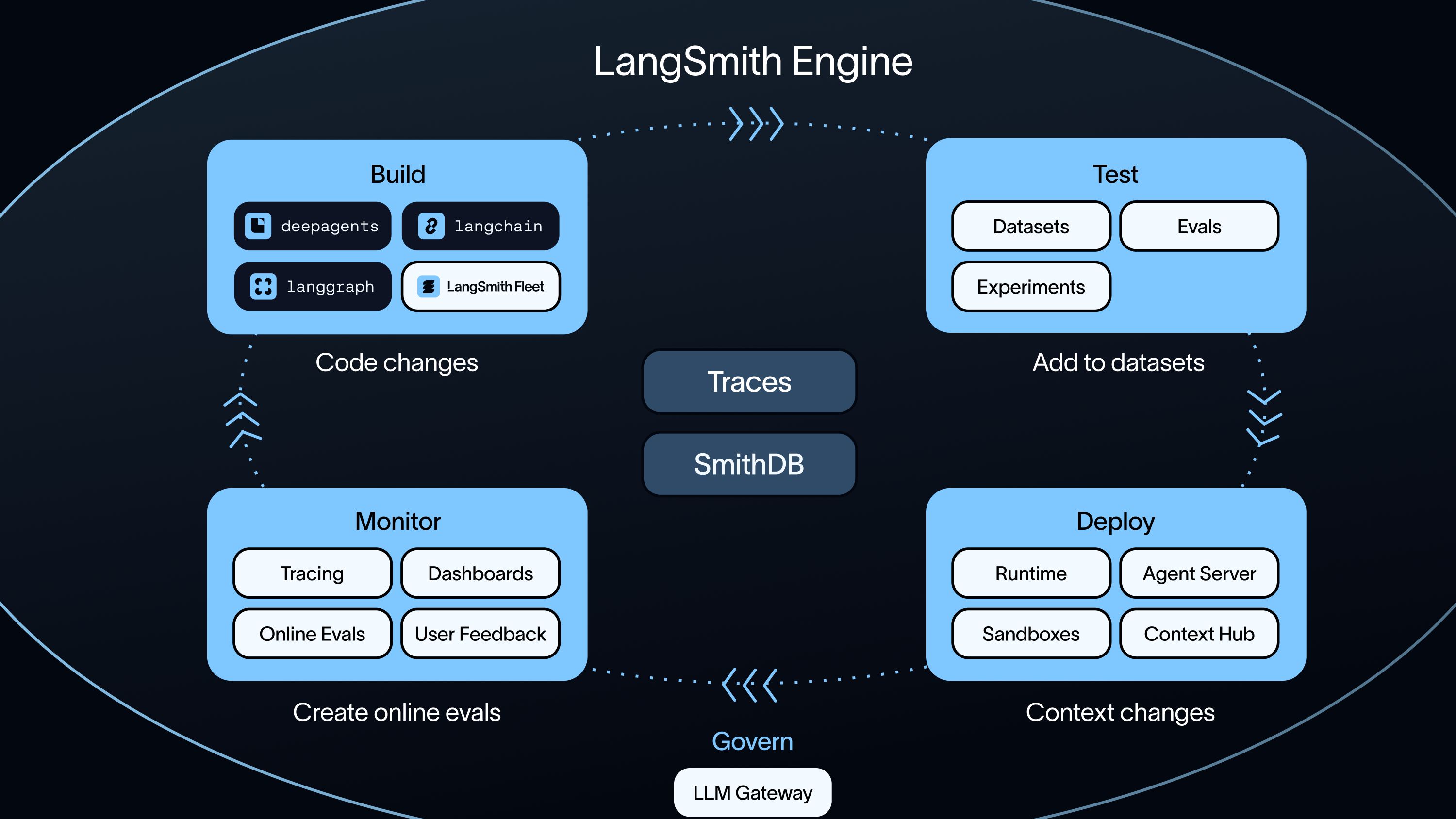
- LangSmith: our framework-agnostic agent engineering platform for observability, evaluation, and deployment that works with the LangChain framework, LangGraph, Deep Agents, or any other stack. LangSmith Engine analyzes production traces, groups related failures, and recommends fixes so your team can improve agent quality faster.
LangSmith closes the loop on what we call the Agent Development Lifecycle: traces feed datasets, datasets feed evals, evals feed improvements, and the new traces start the cycle again. Run offline evals on curated datasets and online evals on production traffic using LLM-as-a-judge evaluators. Insights categorizes traces into actionable patterns and surfaces failure modes you wouldn't have caught through manual review.
Use your favorite framework and you'll always get full trace visibility. That's true whether you're building with the LangChain framework, LangGraph, Deep Agents, the OpenAI Agents SDK, Microsoft Agent Framework, Mastra, or custom code.
Get a demo of LangSmith's agent engineering platform | See all LangSmith services
The information provided in this article is accurate at the time of publication. Tool capabilities, pricing, and availability may change. Always verify current specifications on official websites.