Key Takeaways
- Credit Genie needed a better way to keep codebase knowledge current. As its AI and ML Engineering teams scaled, docs in Notion, READMEs, and AGENTS.md files became stale and hard to find.
- OpenWiki turned documentation into part of the development lifecycle. Credit Genie uses OpenWiki to automatically generate and update repo-level documentation based on code changes.
- The team built a searchable portal across repositories. By aggregating OpenWiki docs into a GitHub Pages portal, Credit Genie gave engineers and stakeholders one place to search and understand systems.
- The system helps both people and coding agents. Engineers use the portal to understand unfamiliar systems, while coding agents are prompted to check the
openwiki/folder before making changes. - Automation removed the maintenance burden. Nightly OpenWiki runs, automated PRs, auto-merge workflows, and daily portal rebuilds keep documentation fresh without relying on manual upkeep.
- OpenWiki reduced tribal knowledge. Important context is no longer locked with individual contributors, making onboarding and cross-functional collaboration easier.
- Credit Genie’s next step is cross-repo awareness. The team plans to connect OpenWiki with its internal knowledge graph so docs can show how repositories depend on each other and how changes may affect related systems.
Credit Genie is a mobile-first financial wellness platform designed to help individuals take control of their financial future. Its AI and ML Engineering teams use OpenWiki, LangChain's open-source repo-documentation agent, to build a self-serve portal that aggregates documentation into a single, searchable, human-readable interface.
Credit Genie turns documentation into a living system with OpenWiki
As Credit Genie's AI and ML Engineering teams scaled across an ever-growing codebase, keeping documentation current became increasingly difficult. Knowledge about individual projects started to become siloed with their contributors, and pockets of "tribal knowledge" began building up.
Attempts to formalize manual documentation processes fell short, since writing and maintaining good docs takes time away from other pressing work. For busy teams, documentation becomes a high-churn activity that requires constant upkeep.
To solve this, Credit Genie adopted LangChain's OpenWiki to fully automate the generation and maintenance of high-quality repository documentation, making it easy for both humans and coding agents to find the information they need.
The challenge: outdated documentation and tribal knowledge
Before OpenWiki, the team maintained project-specific Notion pages, README files, and AGENTS.md files. However, in Credit Genie’s fast-moving environment, that content quickly became obsolete.
Docs both became stale and hard to find, and not just for people. Coding agents working across the codebase ran into the same problem: without a reliable source of truth, they had a hard time understanding what a repository did or how a subsystem worked, and would often act on outdated or incomplete context.
The team recognized that important knowledge was becoming increasingly concentrated in individuals. Answers to questions about what a repository did, where a feature lived, or how a particular subsystem worked were often slow to find and sometimes hard to get at all – whether the one asking was a teammate or a coding agent.
The solution: repo-level docs with a human-facing portal
What originally started as a side project for Mattia Ciollaro, Credit Genie’s Head of AI and ML, has evolved into an "institutional knowledge insurance policy" for his teams.
Mattia adapted OpenWiki to build a self-serve portal hosted on GitHub Pages that aggregates OpenWiki docs across all onboarded repositories into a single, searchable web interface. The result is a system that not only gives his teams a daily source of trusted context, but also helps coding agents perform better by surfacing the right information faster, reducing guesswork, and keeping implementation grounded in the source of truth: the code itself.
The system serves two audiences:
- Team members, who use the centralized GitHub Pages portal to search and read documentation across all repositories in one place.
- Coding agents, which are instructed to check the openwiki/ folder in a repository before taking action.
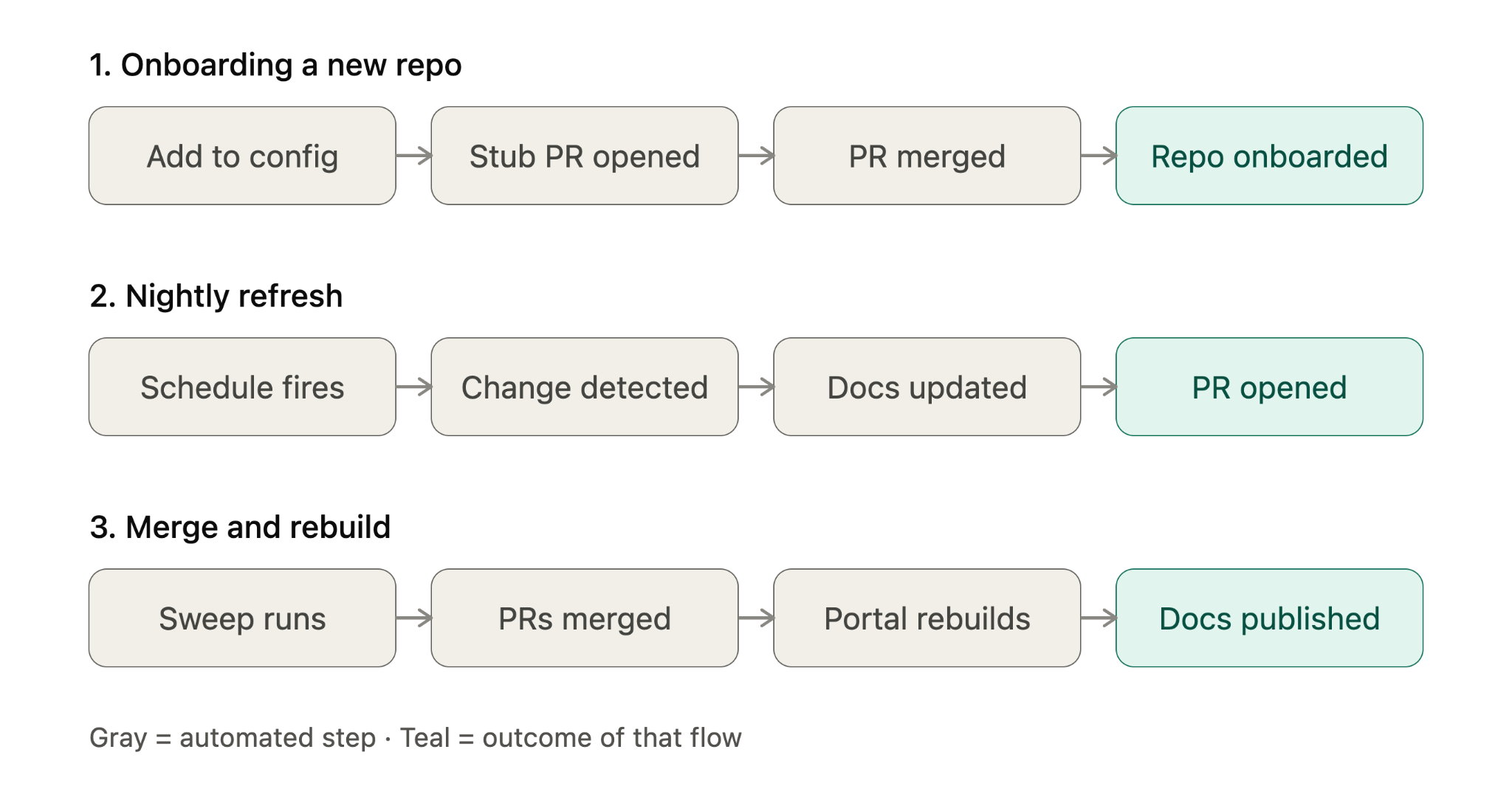
The documentation lives inside each project repository in the openwiki/ folder. OpenWiki runs nightly, checks for commit changes, and generates documentation updates when it finds meaningful differences, opening a pull request in the repo. Onboarding a new repo requires just one change in the portal config, which triggers an automated pull request that adds a customized version of the OpenWiki GitHub Actions workflow to the target repo.
To eliminate merge bottlenecks, Credit Genie added an action to automatically approve and merge OpenWiki update PRs, removing human friction from the documentation maintenance process. A sweep job runs daily across all onboarded repositories, merges pending OpenWiki updates, and rebuilds the portal so the latest content is always available.
This gave Mattia and his teams a simple, scalable way to turn docs into a part of the development lifecycle rather than a separate maintenance burden.
"OpenWiki allows us to make documentation part of the code lifecycle, instead of treating it like a separate chore," said Mattia.
How the teams use it
OpenWiki is used in two distinct ways at Credit Genie:
- At the repo level, it helps coding agents quickly orient themselves before making changes. Coding agents are explicitly prompted to look for the openwiki/ folder when they check out a repository, giving them a faster way to understand unfamiliar systems.
- At the portal level, it acts as a human-friendly knowledge hub. Mattia and other stakeholders use it to refresh their understanding of complex software systems. This allows them to have meaningful cross-functional conversations and ensure that both technical and non-technical stakeholders have a shared understanding of what these systems do and how they relate to each other.
As Mattia described it, "To keep track of the continuous evolution of our systems, Engineers and non-technical stakeholders now check the OpenWiki portal. Often, this removes the need to read a substantial amount of code, which takes effort, or to track down and interview whoever the 'expert' is, which takes time and coordination. High-quality, autogenerated documentation that's always up to date removes both of those obstacles and allows everyone to learn how our systems work any time the need arises."
Early impact
Mattia’s teams are already seeing strong adoption and practical value. The biggest gains so far include:
- Faster access to context across repositories
- Elimination of "tribal knowledge"
- Better onboarding for Engineers and other stakeholders
- More confident cross-functional conversations around unfamiliar systems
- Discoverability via a one-stop-shop searchable documentation portal that stays current without manual upkeep
What's next: cross-repo awareness
Credit Genie's next goal is to make OpenWiki even more intelligent by incorporating its internal cross-repository knowledge graph and progressively onboarding all Credit Genie Engineering teams and code repositories.
“Ian Yoder and Anela Trakic, from our Web team, and Patrick VanDusen, from our Application team, helped us understand that we could scale the system. They added a number of their team repositories and verified the accuracy of the generated docs. AI gets everyone excited and creates great opportunities to collaborate across departments,” Mattia added.
This is a joint effort with Adil Hashem, Credit Genie's Head of Engineering, and the Engineering teams who are building internal AI tools – including LLM gateways, custom CLIs, and GraphRAG code graphs.
Today, Credit Genie’s Engineering teams already map how repositories and projects depend on one another. The next phase is to bring that graph into OpenWiki so documentation can show not only what a repository does, but how it connects to other systems and how changes could ripple across them. This will give all engineers and coding agents at Credit Genie a clearer view of blast radius before making code changes.
Try OpenWiki
Want docs that stay up to date with your code? Try OpenWiki and set it up on your own repos.