LangChain vs. AutoGen
June 23, 2026
The honest 2026 answer to "LangChain vs. AutoGen" is that the question itself is out of date. AutoGen entered maintenance mode in October 2025, Microsoft Agent Framework reached 1.0 GA in April 2026, and the comparison is now LangGraph against Microsoft Agent Framework.
If you're running framework selection today, most of the content you’ll find online predates at least one of those milestones. AutoGen is no longer the framework Microsoft recommends for new projects, and the architectural decisions that defined AutoGen 0.4 have been superseded by a typed-graph workflow model that shares AutoGen's lineage but operates on different principles.
The 2026 reset for AutoGen
The AutoGen GitHub README now states it directly:
"AutoGen is now in maintenance mode. It will not receive new features or enhancements and is community managed going forward."
The README directs new users to start with Microsoft Agent Framework and points existing users to the AutoGen → Microsoft Agent Framework migration guide.
LangGraph 1.0 GA shipped on October 22, 2025. The 1.0 release announcement described it as the first stable major release in the durable agent framework space, a major milestone for production-ready AI systems. Microsoft Agent Framework then reached version 1.0 for both .NET and Python in April 2026: "the production-ready release: stable APIs, and a commitment to long-term support." Both milestones arrived within months of each other, which means most existing comparison content covering AutoGen as an actively maintained AI agent framework is working from outdated facts.
AutoGen is now community managed, which changes both the pace of new features and the speed of issue resolution. For teams making a long-term architecture decision, that shift should be taken into account. Before maintenance mode, triage and fixes generally moved at a Microsoft staffing cadence. Now, turnaround depends on community contributors, while new platform capabilities, like typed-graph workflows and session-state management, are landing in Microsoft Agent Framework (MAF), not AutoGen.
LangGraph as a durable runtime
LangGraph models agent workflows as explicit directed graphs with typed state, checkpointing at every super-step, first-class human-in-the-loop, and durable execution that resumes after crashes or deploys when a durable persistence backend is configured.
LangGraph is a low-level orchestration framework and durable runtime for building, managing, and deploying long-running, stateful agents. In LangGraph’s framing, durable execution is the foundation for everything else. Without durable state, the execution context cannot survive interruptions.
LangGraph's persistence layer backs this up mechanically. The LangGraph docs state:
"LangGraph has a built-in persistence layer that saves graph state as checkpoints. When you compile a graph with a checkpointer, a snapshot of the graph state is saved at every step of execution, organized into threads."
The state of a thread at a particular point in time is a checkpoint, saved at each super-step, and per-task pending writes within a step are persisted too, so partial progress survives mid-step failure. A crash, a deploy, or a transient infrastructure failure mid-reasoning-loop does not erase the work leading up to it.
LangGraph centers durable execution as the capability that takes a runtime from prototype to production. LangGraph's persistence layer enables human-in-the-loop workflows, conversational memory, time travel debugging, and fault-tolerant execution. Durable execution with checkpointing, persistence, streaming, and human-in-the-loop continues to be first-class. Interrupted threads do not consume runtime resources beyond storage and can be resumed later from the same checkpoint. That resumption guarantee benefits from a production-grade persistence backend (Postgres or an equivalent managed store). The default InMemorySaver does not survive process restarts; SQLite is recommended only for experimentation and local workflows. Also, each super-step write trades latency for durability, so plan for it up front when you have tight latency budgets or high fan-out subgraphs.
Low-level primitives give you the flexibility to design control flows for single agents, multi-agent systems, and hierarchical patterns. LangGraph’s interrupt() API is a good example. Unlike static breakpoints that only pause before or after specific nodes, interrupt() can be used dynamically: in flat-graph code, behind conditionals, or even inside a tool function. When it triggers, it surfaces an approval payload to the caller and the checkpointer persists the thread state at that super-step, so you can resume cleanly via Command(resume=...). The shared-checkpointer behavior in nested subgraphs is worth testing carefully before relying on it for production HITL. For high-stakes autonomous agents that require review before certain tool calls, this is a first-class API.
Microsoft Agent Framework, beyond Azure
Where LangGraph centers Python-first graph execution with first-class JS/TypeScript support, Microsoft Agent Framework merges AutoGen's multi-agent abstractions with Semantic Kernel's enterprise features and adds typed, graph-based workflows with sequential, concurrent, handoff, and group-collaboration patterns, plus a supported provider list that includes OpenAI, Anthropic, and Ollama, not only Azure OpenAI and Foundry. MAF adds full .NET parity at the same 1.0 milestone, which LangGraph does not offer.
"Semantic Kernel and AutoGen pioneered the concepts of AI agents and multi-agent orchestration. The Agent Framework is the direct successor, created by the same teams."
The merger is intentional: it combines AutoGen's simple abstractions for single- and multi-agent patterns with Semantic Kernel's enterprise-grade features, including session-based state management, type safety, filters, telemetry, and extensive model and embedding support.
The workflow model is typed and graph-based. The Microsoft Learn overview describes MAF's two primary capability categories:
Agents: Individual agents that use LLMs to process inputs, call tools and MCP servers, and generate responses. Supports Microsoft Foundry, Anthropic, Azure OpenAI, OpenAI, Ollama, and more.
Workflows: Graph-based workflows that connect agents and functions for multi-step tasks with type-safe routing, checkpointing, and human-in-the-loop support.
The MAF GitHub README details the supported workflow patterns: "Build multi-agent systems with graph-based workflows supporting sequential, concurrent, handoff, and group collaboration patterns; includes checkpointing, streaming, human-in-the-loop, and time-travel." Each pattern (sequential, concurrent, handoff, group) governs how agents coordinate and hand off work. Agents handle reasoning and tool selection and workflows govern execution policy and control flow.
The official providers matrix lists Azure OpenAI with full Azure identity support, Anthropic with Claude models including extended thinking and hosted tools support, Ollama for running models locally, Microsoft Foundry, Foundry Local, GitHub Copilot, Copilot Studio, and a custom provider path by implementing the AIAgent base class in .NET or BaseAgent in Python. Which means teams outside the Azure ecosystem can use MAF without routing traffic through Azure infrastructure.
AutoGen's v0.4 rewrite introduced "an event-driven core with a high-level Team," Agent Framework "centers on a typed, graph-based Workflow that routes data along edges and activates executors when inputs are ready." That is a different control-flow model: message-passing GroupChat gives way to typed edges that route data between nodes, activating executors only when inputs satisfy the type contract.
AutoGen and the migration question for legacy users
If your team is on AutoGen v0.4 or v0.6+, read Microsoft's AutoGen-to-Microsoft-Agent-Framework migration guide before starting any new work. Microsoft now positions MAF as the path forward for both AutoGen and Semantic Kernel users, and AutoGen will receive only critical bug and security fixes from here.
"AutoGen is now in maintenance mode. It will not receive new features or enhancements and is community managed going forward."
Teams that built GroupChat patterns and the event-driven actor model in AutoGen v0.4 will find those patterns continuing to run without breaking changes, but the framework they are running on will not gain the orchestration capabilities that MAF adds, including the typed-graph workflow model, the checkpointing mechanics, and the session-state management Semantic Kernel contributed.
AutoGen originally gained adoption for its conversational agent patterns: GroupChat, multi-turn coordination, and the event-driven actor model introduced in v0.4. Those patterns worked well for collaborative reasoning tasks. MAF supersedes them with a typed, graph-based control flow model. The migration guide describes MAF as "a significant evolution of the ideas pioneered in AutoGen" that incorporates lessons from real-world usage, and names the key behavioral difference: "AutoGen pairs an event-driven core with a high-level Team. Agent Framework centers on a typed, graph-based Workflow that routes data along edges and activates executors when inputs are ready." For teams with substantial GroupChat or actor-model code, migration is closer to an architectural rewrite than a linear porting exercise.
One concrete behavioral difference worth calling out: "Agent behavior: AssistantAgent is single-turn unless you increase max_tool_iterations. Agent is multi-turn by default and keeps invoking tools until it can return a final answer." Teams that relied on the explicit single-turn behavior will need to adjust their agent design for MAF.
Microsoft Agent Framework is positioned as the successor to both Semantic Kernel and AutoGen for building AI agents. "If you've been building agents with Semantic Kernel or AutoGen, Agent Framework is the natural next step." Starting new work on AutoGen v0.4 or v0.6 in mid-2026 means accepting future migration work.
LangGraph vs. Microsoft Agent Framework, dimension by dimension
Across the nine dimensions that decide production behavior, LangGraph and Microsoft Agent Framework have many similarities. The real differentiators are language ecosystem and integration breadth.
The biggest measurable difference here is ecosystem size. LangChain has 1,000+ integrations, which helps teams keep options open as new models and tools emerge. That number includes model providers, tools, and databases. Microsoft Agent Framework supports fewer providers out of the box, but teams can build custom providers and maintain those integrations over time.
How to choose between the two
Choose LangGraph when your team is Python-first, wants the broadest third-party integration ecosystem, and values an explicit graph orchestration model with production-validated durable execution; choose Microsoft Agent Framework when your team is already on Azure OpenAI or Microsoft Foundry, needs .NET and Python parity, or is migrating from AutoGen or Semantic Kernel.
Choose LangGraph if:
- Your team works primarily in Python or JavaScript/TypeScript and needs the widest possible integration surface across LLM providers, vector databases, and tool ecosystems
- The agent architecture requires explicit, auditable graph control flows where every branching decision is inspectable and testable
- Durable execution across deploys or failures is a hard requirement for workflows that run longer than a single request-response cycle
Choose Microsoft Agent Framework if:
- Your team is already building on Azure OpenAI, Microsoft Foundry, or the broader Microsoft enterprise AI stack, where MAF's supported provider integrations and Azure identity support eliminate integration work
- .NET and Python parity is a requirement, with both runtimes now at the same 1.0 GA milestone
- Your team is migrating from AutoGen or Semantic Kernel and wants a documented migration path with the same team behind it
- The workflow patterns you need map cleanly to MAF's sequential, concurrent, handoff, or group-collaboration models
You may not need either full framework as an AI agent framework at all. Single-agent applications that issue an LLM call per user request (e.g. a RAG pipeline over a document store, a simple Q&A endpoint) do not maintain durable state across sessions and do not require human-in-the-loop approval gates. Those can run on the OpenAI SDK or Anthropic SDK directly with LangSmith tracing in front. Reach for LangGraph or MAF when persistence, multi-step orchestration, or HITL becomes a hard requirement.
Observability is a separate decision
Whichever orchestration framework you pick, the operational layer above it, tracing, evals, annotation queues, and deployment, is a separate decision, and LangSmith is our framework-agnostic agent engineering platform that works with LangGraph, Microsoft Agent Framework, Deep Agents, OpenAI SDK, Anthropic SDK, or custom code.
Choosing LangGraph does not commit your team to LangSmith, and choosing Microsoft Agent Framework does not preclude it. Use your favorite framework and you will get full trace visibility either way. LangSmith is the framework-agnostic agent engineering platform for observing, evaluating, and deploying agents.
Traditional observability and uptime monitoring can tell you whether an agent is running, but not whether it is accomplishing the user’s goal. Code sets the boundaries of what an agent can do, while traces provide the record of what the agent did and why. To judge quality and drive improvement, you need feedback layered on top of traces, from users, evaluators, or rules. Agents are difficult because you cannot anticipate every input, and an LLM decides outputs at runtime.
LangSmith Evaluations supports three complementary eval methods: offline evals run test datasets before deployment to catch regressions before they reach users; online evals run on sampled production traffic to monitor quality drift after deployment; and LLM-as-a-judge evaluators apply rubric-based scoring at scale. Align Evals translate human feedback into reproducible evaluation criteria so the rubric improves alongside the agent.
Traces also power Insights, which automatically analyzes trace data to surface usage patterns, common agent behaviors, and failure modes. Those findings become datasets, datasets become evals, and evals validate improvements. As you ship fixes, you generate new traces and the loop continues. That is the full Agent Development Lifecycle: monitor real usage, turn failures into test cases, run evaluations, deploy improvements, and then watch production again.
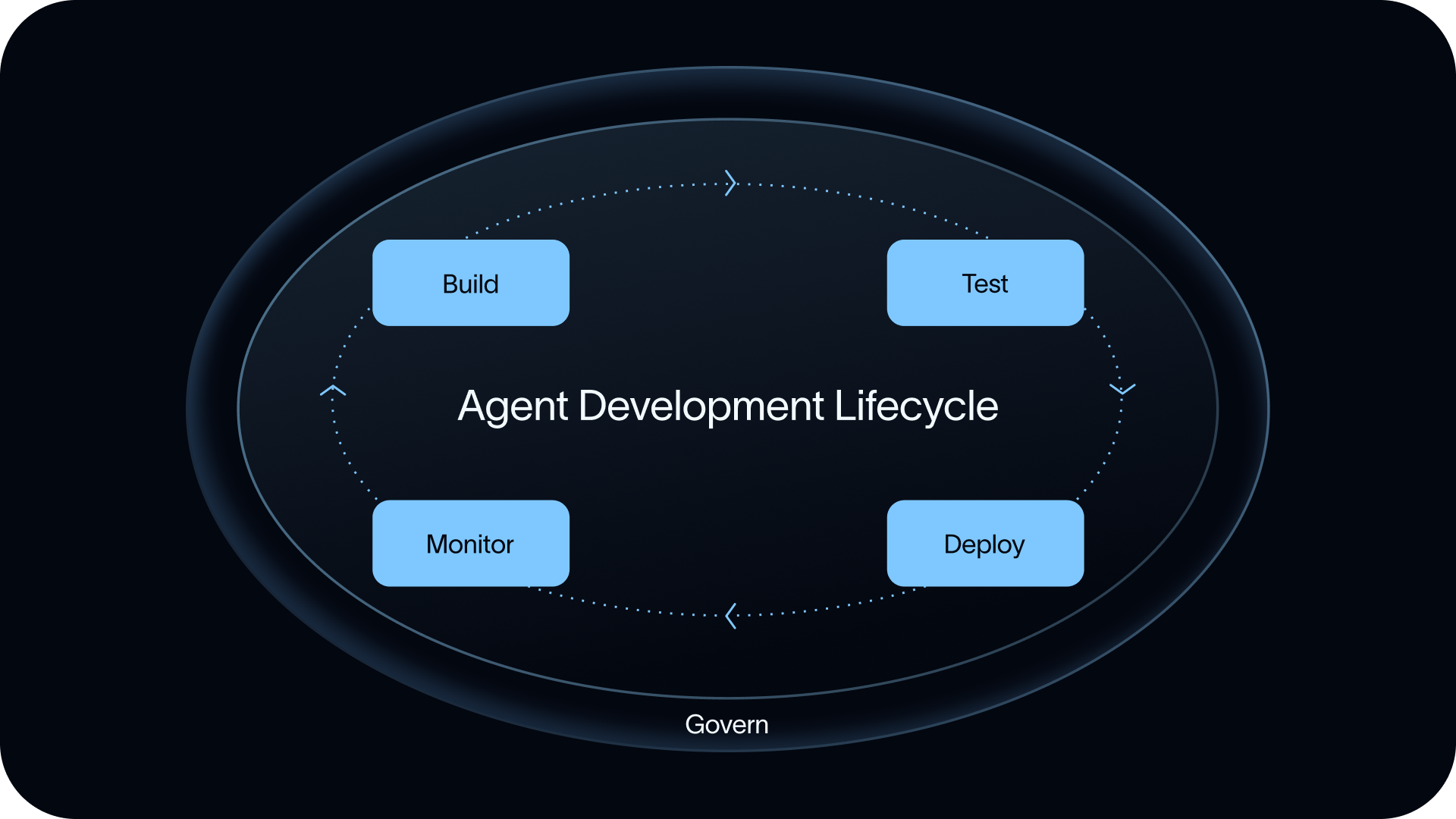
Framing the 2026 framework decision as a single choice is how teams accidentally bundle two separate architecture decisions into one commitment. The orchestration choice (LangGraph vs. Microsoft Agent Framework) determines how your agent executes, persists state, and routes control flow. The operational-layer choice determines how you trace it, evaluate it, and improve it. Those are orthogonal decisions with different evaluation criteria and different switching costs. Committing to an observability stack just because it ships alongside your chosen orchestration framework can make later migrations harder than they need to be.
Start with LangSmith tracing on whatever is in your prototype branch now, LangGraph, Microsoft Agent Framework, the OpenAI SDK, or custom code. Pull one production trace end to end and watch what the agent did versus what you expected. Find one real failure, add it as your first regression dataset entry, and the agent improvement loop has started. From there, you can evaluate orchestration on its own merits and treat the operational layer as a separate decision.