
Key Takeaways
- Generic AI alone will not create lasting advantage
- Companies need control over their models, agent systems, context, and memory
- Owning intelligence also means managing its cost, quality, risk, and behavior
- Advantage comes from a feedback loop that improves the system with use
- Buy the generic infrastructure, but own the intelligence that compounds
Over the next five years, every company will use AI in one of two ways: to run critical parts of their business, or as part of the product they sell to customers. In both cases, generic intelligence will not be enough.
To have real impact, companies need to own their intelligence. Ownership does not mean building every layer from scratch. It means controlling the parts that determine how intelligence behaves, how it’s managed, and whether it compounds over time.
Off-the-shelf intelligence does not know your business
Off-the-shelf AI is useful because it is general. It can answer common questions and reason across a broad set of topics. This makes it helpful to get started. But to assume that generic intelligence can run operations inside a company would be a gross simplification.
Companies have MANY specifics in the way they operate. The deeper you embed AI into your company, the more these specifics matter. If you are hoping to use AI as a core part of operating your company, these specifics matter a lot.
As a concrete example, let’s consider a large insurer using AI to help process claims. A generic model can read a policy document, summarize a claim, and explain common coverage concepts. But to actually do the work to handle a claim depends on the insurer’s own policy language, state-by-state regulatory requirements, fraud signals, historical claim patterns, escalation rules, customer tiering, and risk tolerance. These specifics will not be in a generic models weights. A generic model knows the meaning of the word “deductible”. But it does not know how to handle a specific type of claim, for this customer, in this jurisdiction, under this policy, with this evidence.
The same logic applies when AI is the product itself. If you are a vertical AI startup building an AI support agent, legal assistant, or coding agent - the base model is not your product. Everyone else can call the same API. Your product is the system around the model: the workflows it handles, the context it retrieves, the tools it can use, the evals that define quality, the memory it builds, and the feedback loop that improves it with every customer interaction.
In both cases, the advantage is not generic intelligence. It is intelligence adapted to a specific business.
Any company can use AI. But this generic intelligence will not be enough to drive meaningful ROI or build a differentiated product. Companies built around AI will own their intelligence.
What it means to own your intelligence
Owning your intelligence does not mean building every layer of the AI stack yourself. It means controlling the critical parts - the parts that determine how intelligence behaves, what it learns from, how much it costs, and whether it improves over time.
A useful analogy here: the supply chain. A retailer does not need to manufacture every truck, ship, or warehouse robot it uses. But it does need to own the system that determines what gets sourced, how inventory moves, how demand is forecast, and how the customer experience is delivered.
AI works the same way. You can buy models, compute, and infrastructure. But you need to own the system that turns those inputs into intelligence specific to your business.
There are three parts to this: controlling the agent system; owning the economics, quality and risk; and compounding the intelligence over time.
Controlling the agent system
An agent is the bridge between raw intelligence and work. The model provides the intelligence. The harness determines how that intelligence is applied. Context tells the system what matters in a specific situation.
The first layer is the model. Owning the model can mean using open-weight models when sovereignty, portability, or deployment control matters. It can also mean preserving model optionality: the ability to switch across providers as quality, cost, latency, and privacy requirements change. Optionality is defensive because it avoids lock-in. It is offensive because it lets you adopt the best model as soon as it appears.
The second layer is the harness: the orchestration logic that turns model outputs into actions. The harness controls everything around how context is used: routing, tool use, workflow steps, skills, and more. This is where much of the company-specific behavior lives. If the harness is closed, you are accepting someone else’s assumptions about how your agent should work.
The third layer is the context itself. Context is what makes generic intelligence specific: documents, policies, tools, skills, user preferences, organization-level knowledge, and memory. Memory is especially important because it is how the system becomes more useful over time.
If you do not own context and memory, you do not own the intelligence your system accumulates.
To own the agent system, you need control over all three: the model, the harness, and the context.
Own the economics, quality, and risk
Once AI is doing real work, companies need to manage it like any other operating system. That means controlling the cost of the work, measuring its quality, defining where the system can act, and knowing what happened when it does.
Cost matters because intelligence is only valuable if it is cheap relative to the return it generates. As AI adoption has increased rapidly, so have costs - see Uber’s cautionary tale as an example.
Being able to lock down costs - on a user, orgs, or agent level - is crucial to being able to scale AI reliably.
Quality needs to be measured, not assumed. If you upgrade a model, change a prompt, add a tool, or adjust a workflow, you need to know whether the system got better or regressed. If you are unable to measure this, you are unable to improve your agent systematically, which means you are unable to truly control and own it.
Boundaries define where AI can act independently and where it needs supervision. Companies need to control what data agents can access, what tools they can use, which actions require approval, and when they should escalate. Owning your intelligence means controlling what it can do.
Observability makes the system accountable. If an agent takes an action, the business needs to see what it saw, what it did, what tools it called, and why. This is important for both being able to improve the system but also being able to audit and trust the system.
Compound your intelligence
The best AI systems get better with use. The 100th interaction should be more valuable than the 1st because the system has learned more about your users, workflows, policies, failures, and preferences. You need to own both what the system has learned, as well as the learning process itself.
What does it mean for a system to learn?
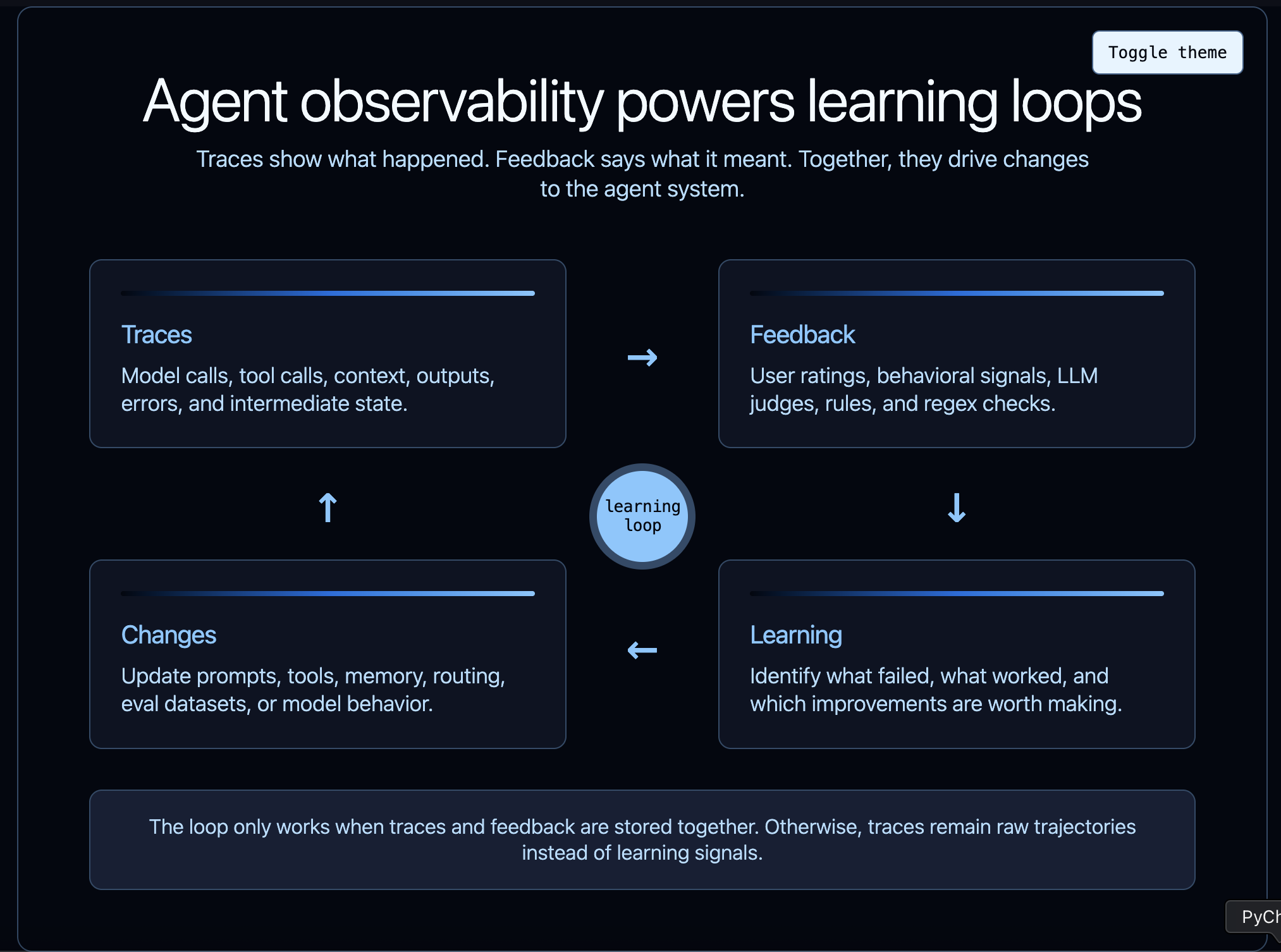
That learning loop starts with traces. Traces show what the agent actually did: what context it saw, what tools it called, where it got stuck, and what it produced. Feedback gives those traces meaning: whether the behavior was useful, accepted, rejected, inefficient, risky, or wrong. Together, traces and feedback become the raw material for improvement.
Those traces and their associated feedback can be used to improve the system - by changing the prompts, harness, tools. But just as important as those changes are the evals associated with those changes. For every change, you should be adding an eval to capture that change, and make sure that future changes don’t cause regressions.
At a bare minimum, these learnings need to be owned by you. They need to be portable from from model to model, from system to system. Even more - you should own this entire loop yourself. Again - it doesn’t really matter how well the agent does the first time someone uses. It matters how much better it is the 100th time they use it. If that’s what matters, then you need to own the loop that drives that.
A checklist for owning your intelligence
Do you truly own your intelligence? Here’s a set of questions you should be asking yourself to determine that:
[ ] If a brand new model provider launched a SOTA model tomorrow, could you easily switch to it?
[ ] If the model provider you are using deprecates a model - could you host it yourself to avoid any disruption?
[ ] Do you know - and can control - how the orchestration logic works, such that you can know and control exactly what goes into the LLM at every step?
[ ] Can you run your agent in the exact same way in one cloud vs another vs on device?
[ ] Can you monitor and control AI spend on per user basis?
[ ] If someone asks why an agent did something, can you show them a full trace of all the steps they did (and any internal logic for why they did that?)
[ ] Do you have evals in place to be confident that swapping models won’t introduce regressions?
[ ] When a user uses your agent for the 100th time, will it know more about them and be a better experience than when they used it for the 1st time?
[ ] When your agent learns - can you port those learnings to a different system entirely?
[ ] Can you control how your agent learns?
The strategic choice
Companies do not need to build every layer of the AI stack. They should buy the parts that are hard, generic, and undifferentiated.
But they need to own the layer where advantage compounds: the agent system, the governance around the work it does, and the feedback loop that makes it better with use.
Any company can adopt AI. The companies that create lasting value with AI will be the ones that own their intelligence.